
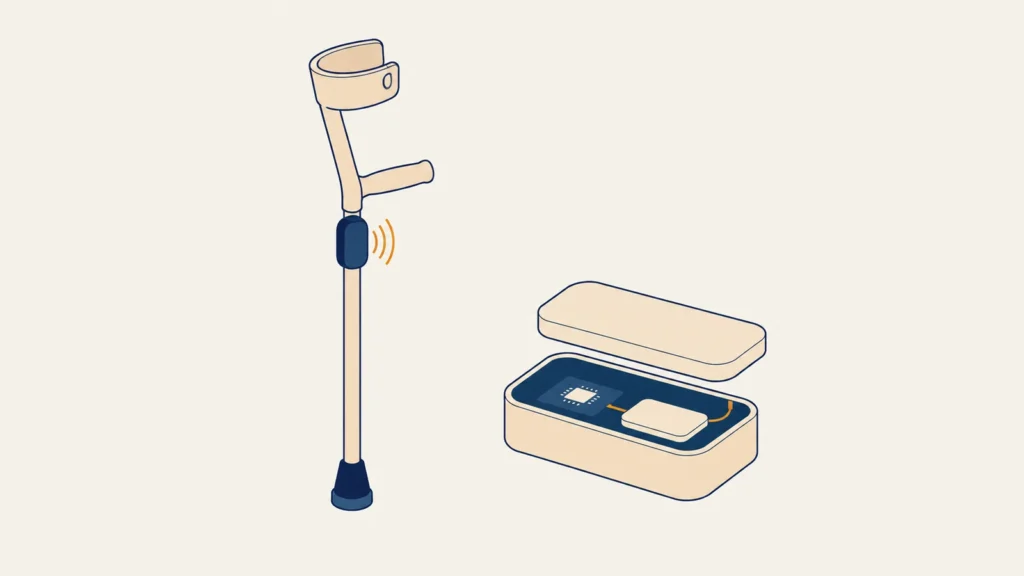
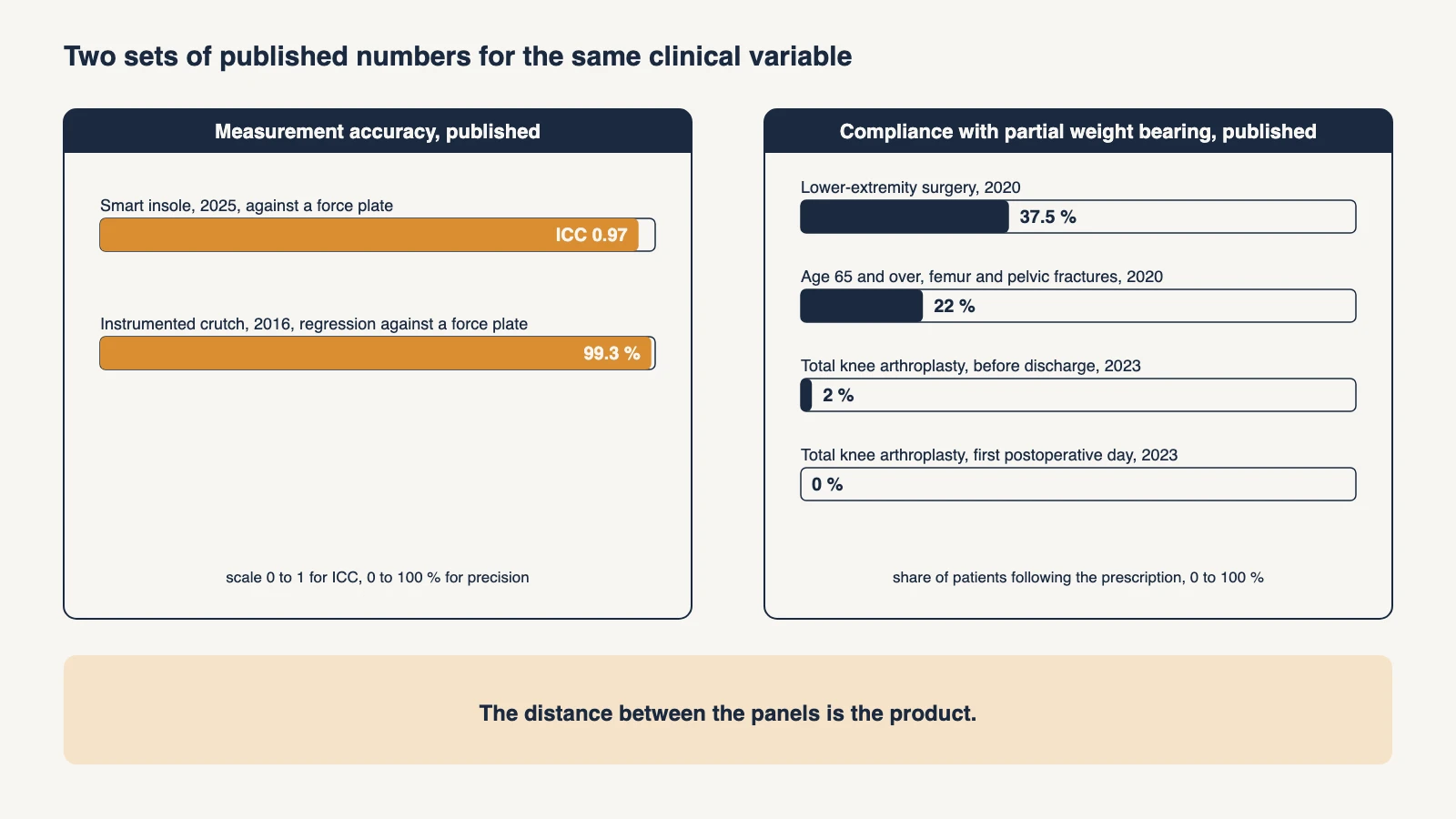
On a rehabilitation crutch that doses limb loading, the load cell is the solved part. Published measurement accuracy sits near an intraclass correlation of 0.97, while published compliance with partial weight bearing runs between zero and 38 percent. The engineering budget belongs in the feedback loop: feedback that arrives within the step and never asks the patient to look down.
Partial weight bearing is standard practice after lower-extremity surgery, and it is also one of the least reliably executed instructions in orthopedic rehabilitation. A 2020 study of lower-extremity surgery patients found overall compliance around 37.5 percent. Among patients aged 65 and over with femur and pelvic fractures, compliance fell to 22 percent. A 2023 trial of total knee arthroplasty patients recorded zero percent compliance on the first postoperative day and 2 percent before discharge.
Measurement, by contrast, is a solved problem. A 2025 validation of a smart insole reported an intraclass correlation of about 0.97 against a force plate, with a standard error of measurement of 1.67 newtons and an R squared of 0.9175. A sensor-based instrumented crutch prototype reached 99.3 percent precision in 2016, as a regression predicting force-plate load from the crutch instrumentation.
The gap between those two sets of numbers is the entire product opportunity, and it explains why the engineering effort that pays on a rehabilitation load device goes into the feedback loop rather than into the load cell.
The program described here was a device that doses crutch loading during rehabilitation, built around load sensors, an nRF52 with BLE, an accelerometer, a low-power battery design, and an injection-molded housing. At OVA Solutions we build medical device hardware as experienced developers, with 62 engineers in house and over 200 devices shipped. Scope covered requirements, concept, industrial and mechanical design, PCB, embedded software, production, and quality control.
The measurement problem hiding inside the measurement
A crutch instrumented with load cells measures load through the crutch. The clinical prescription is load through the limb. Those two quantities are related through the patient’s gait pattern, body weight, and whatever the contralateral limb is doing, and the relationship is not fixed.
A three-point gait with two crutches distributes load differently from a four-point gait, which distributes differently again from a single crutch used contralaterally. So a crutch device infers limb load rather than measuring it, and the quality of that inference varies with how the patient is actually walking on any given day.
This shows up directly in validation results. A 2016 comparison of three commercial biofeedback devices against a force plate found substantial agreement for SmartStep, moderate for OpenGo, and slight for SensiStep, at weighted kappa of 0.76, 0.58 and 0.19. Those are not differences in sensor quality. They are differences in what each device measures and how well its inference holds up.
The practical requirement is to define the clinical claim against the measured variable rather than the prescribed one, and to validate the inference across gait patterns rather than in standing. A device validated standing still on a force plate will look excellent and behave unpredictably in a corridor.
Feedback modality is a safety decision
The indicated population skews elderly, and the documented reasons for non-compliance are pain, dizziness, dislike of the device, and simply not understanding the instruction.
That set of reasons rules out an entire design direction. Visual feedback on a crutch requires the patient to look down at a display while walking on a partially loaded limb with a mobility aid, which describes the mechanism of a fall in exactly the population most likely to have one. Any display on this device is for the clinician during a session, not for the patient during gait.
The evidence also happens to favor the safer choice. A 2014 study found haptic biofeedback outperformed both verbal instruction and bathroom scale training, at 22.4 pounds of loading against 43.8 for the scale and 60.3 for verbal instruction. A 2023 study of biofeedback during stair climbing raised the proportion of steps under 20 kg from 36.6 and 39.1 percent up to 61.1 and 66.1 percent. A 2024 randomized controlled trial of ambulatory biofeedback kept healthy participants in the overload zone for no more than 8.4 percent of steps, with more than two thirds of steps landing in the target zone.
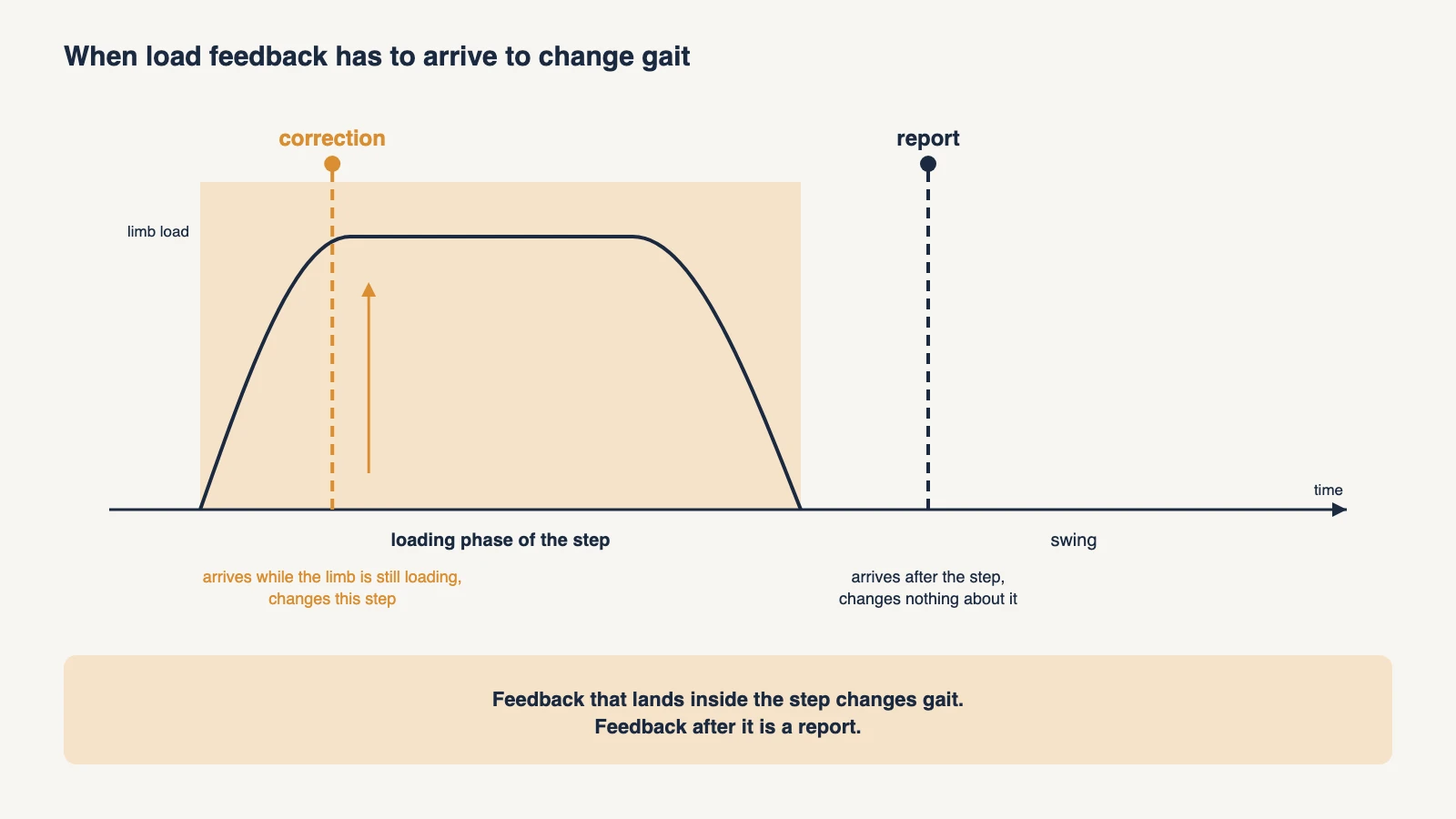
Feedback also has to arrive within the step that produced it. Load information delivered after the fact is a report. Load information delivered during the loading phase is a correction, and only the second one changes gait. That timing requirement sets the sampling rate, the processing latency, and the actuator choice, and it is worth writing into the requirements document as a number before anyone selects a haptic motor.
The housing decides the unit economics before the electronics do
For an injection-molded ABS or polycarbonate medical housing, our own cost modeling puts total unit cost in the range of roughly $0.51 to $2.45 at 10,000 units per year, and roughly $0.33 to $1.35 at 50,000. Resin cost sits around $0.15 to $0.35 in both cases. The variable that moves is tooling amortization, which runs about $0.20 to $1.50 or more per unit at 10,000 and about $0.05 to $0.50 at 50,000. Tooling itself ranges from $3,000 to $100,000 depending on complexity, cavity count, steel grade, and finish.
The consequence is that the volume forecast is a more expensive thing to get wrong than the part geometry. A program that tools for 50,000 and sells 8,000 has bought a cost structure it cannot escape without a second tool.
Two mitigations are worth designing in from the concept phase. Build the housing so that one tool with interchangeable inserts serves several configurations, which spreads the amortization across SKUs rather than stranding it in one. And where the forecast is genuinely uncertain, run a bridge process for the first production block, accepting a higher piece price in exchange for deferring the tooling commitment until real demand data exists.
The short version for a program director
Treat load sensing as commodity and spend the engineering budget on the feedback loop, because published accuracy is already at an intraclass correlation near 0.97 while published compliance sits between zero and 38 percent.
Write the clinical claim against what the device actually measures, and validate the limb-load inference across gait patterns rather than in a standing test.
Rule out patient-facing visual feedback during gait on safety grounds, and specify feedback latency as a number tied to the loading phase of the step rather than as a general responsiveness goal.
Design the tool for multiple configurations, and treat the volume forecast as the highest-leverage cost decision in the program.
Common questions
Why is adherence, not measurement, the product problem on a rehabilitation crutch?
Because the two published numbers sit so far apart. A 2025 smart insole validation reported an intraclass correlation of about 0.97 against a force plate, and an instrumented crutch prototype reached 99.3 percent precision in 2016. Compliance with partial weight bearing, meanwhile, was 37.5 percent after lower-extremity surgery, 22 percent in patients aged 65 and over, and zero on the first day after total knee arthroplasty. The gap is where the engineering effort pays.
Why does a load-sensing crutch not measure the load the surgeon prescribed?
The prescription is load through the limb, and the crutch measures load through the crutch. The two are linked by gait pattern, body weight, and what the other leg is doing, and that link is not fixed: a three-point gait, a four-point gait, and a single crutch used contralaterally all distribute load differently. A 2016 comparison of three commercial devices against a force plate found weighted kappa of 0.76, 0.58 and 0.19 for that reason.
Why should the patient not get visual feedback during gait?
Because the indicated population skews elderly and the documented reasons for non-compliance include dizziness. Looking down at a display while walking on a partially loaded limb with a mobility aid describes the mechanism of a fall in exactly the people most likely to have one. Any display belongs to the clinician during a session. A 2014 study also found haptic feedback outperformed both verbal instruction and bathroom scale training.
When does load feedback have to arrive to change gait?
Within the step that produced it. Load information delivered after the fact is a report, and load information delivered during the loading phase is a correction, and only the correction changes how the patient walks. That timing requirement sets the sampling rate, the processing latency, and the actuator choice, so it belongs in the requirements document as a number before anyone selects a haptic motor.
Why does the housing decide unit economics before the electronics do?
In our cost modeling, an injection-molded ABS or polycarbonate medical housing runs roughly $0.51 to $2.45 per unit at 10,000 units a year and $0.33 to $1.35 at 50,000. Resin barely moves between the two. Tooling amortization does, from about $0.20 to $1.50 per unit down to $0.05 to $0.50, with the tool itself between $3,000 and $100,000. A program that tools for 50,000 and sells 8,000 owns a cost structure it cannot escape.
How can a program hedge an uncertain volume forecast?
Two ways, both decided at the concept phase rather than at design for manufacturing. Build the housing so that one tool with interchangeable inserts serves several configurations, which spreads amortization across SKUs instead of stranding it in one. And where the forecast is uncertain, run a bridge process for the first production block, paying a higher piece price to defer the tooling commitment until real demand data exists.
Sources: lower-extremity surgery compliance study, 2020 · elderly femur and pelvic fracture compliance study, 2020 · total knee arthroplasty compliance trial, 2023 · smart insole validity and reliability study, 2025 · instrumented crutch prototype validation, 2016 · biofeedback device comparison against force plate, 2016 · haptic biofeedback study, 2014 · biofeedback on stairs study, 2023 · ambulatory biofeedback randomized controlled trial, 2024
Lisa Voronkova is a medical device development expert and CEO of OVA Solutions, an R&D firm of 62 engineers that has shipped over 200 devices. She holds a PhD in applied mathematics and wrote Hardware Bible: Build a Medical Device from Scratch.
If you are building something in this space, we are glad to look at it with you. Grab a slot on Lisa’s calendar at calendly.com/lisa-voronkova/30min, and if nothing there works, write to lisa@ovasolutions.com.
More on this topic: Orthopedics & Rehabilitation