
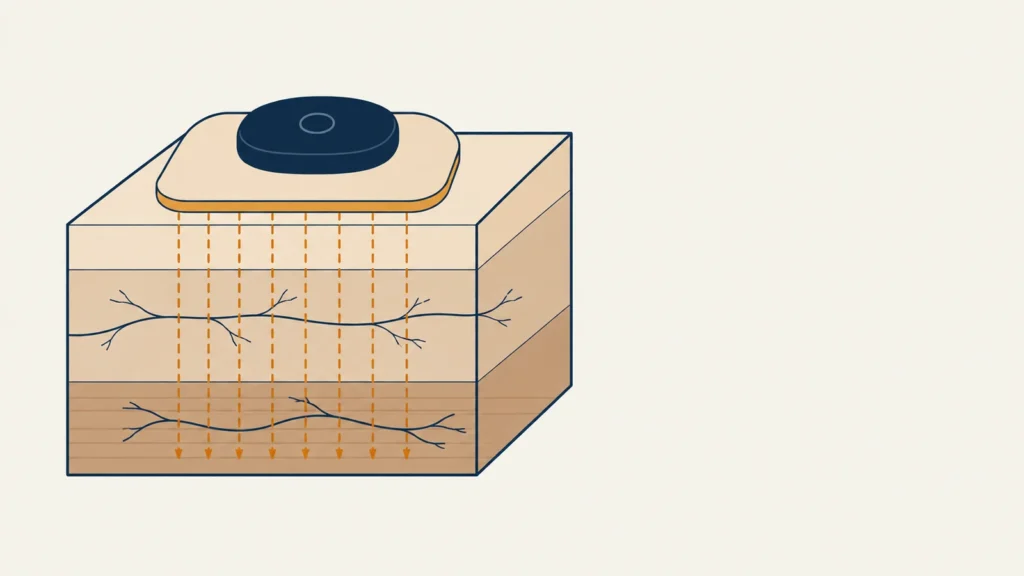
On a wearable stimulator the disposable electrode is the product and the electronics are its support system. The pad sets the load the output stage sees, the comfort that decides whether therapy continues, and the recurring revenue. Design the output stage against an aged pad, measure its impedance in the device, and qualify the hydrogel before submission.
A wearable neuromuscular stimulator for facial muscle re-education is a small system with three parts: a rechargeable Bluetooth module, a mobile app that sets rhythm and intensity, and a disposable pre-gelled electrode that attaches magnetically. The module is sold once. The electrode is bought for as long as the patient stays in therapy.
We are experienced medical device hardware developers at OVA Solutions, an ISO 13485-certified team of 62 engineers with 200+ devices shipped. Our scope on this program was requirements definition, PCB design, embedded software, and quality control. The device received FDA clearance. What is worth writing down is that the dominant constraint on the electronics came from a component outside our scope, and that this is the normal condition rather than an unlucky one.
An electrode is not a fixed load
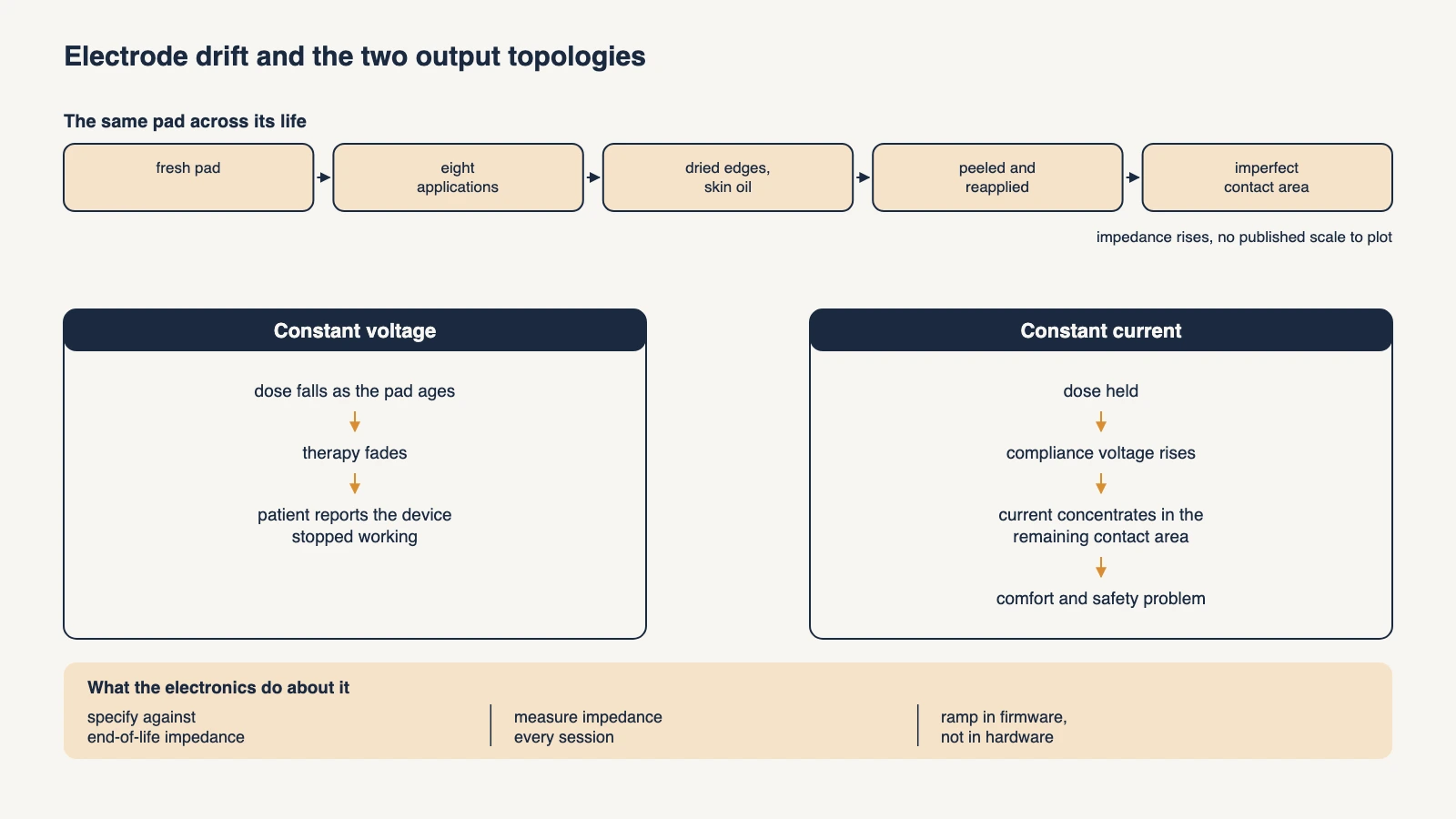
Electrical stimulation is a charge delivery problem, and the path from the output stage to the muscle runs through a hydrogel that changes while you use it. A fresh pad presents one impedance. The same pad after eight applications, partially dried, contaminated with skin oil, and peeled and reapplied several times, presents a substantially different one. Patients also reapply pads with imperfect contact area, which changes current density rather than total current.
That drift is the design problem. A constant-voltage output stage delivers a dose that falls as the pad ages, so the therapy quietly weakens and the patient reports that the device stopped working. A constant-current stage holds the dose but raises compliance voltage into a drying pad, concentrating current in whatever contact area remains, which is a comfort and safety problem rather than an efficacy one.
The clinical evidence on comfort is unambiguous enough to design against. A 2026 study by Wackendal and colleagues found that more than 20 percent of participants reported moderate to high pain, at or above 4 out of 10, during NMES even with a gel pad intervention intended to lower skin impedance. A 2024 study on electrical stimulation and skin vulnerability notes that approximately 40 percent of people who use transcutaneous electrical nerve stimulation develop skin contact dermatitis. A 2021 systematic review of NMES adherence in hip and knee osteoarthritis by Burgess and colleagues lists dislike of the device, pain, and discomfort among the reasons patients stop.
Those findings describe a device that fails commercially through discontinuation rather than through malfunction, and the electronics can either mitigate that or accelerate it.
What the electronics should do about it
Design the output stage against the electrode’s end-of-life impedance rather than its datasheet value, and confirm the range empirically on aged pads rather than fresh ones.
Measure electrode impedance in the device on every session and act on it. A stimulator that can tell the difference between a well-applied fresh pad and a dried pad at the end of its life can derate, warn, or refuse, and it converts an unattributable comfort complaint into a logged data point. On a Bluetooth-connected device with an app already in the system, that measurement also becomes adherence data the clinician can use.
Ramp intensity rather than stepping it, and hold the ramp profile in firmware where it can be revised after human factors testing without touching hardware.
The magnetic attachment deserves its own note. Facial muscle re-education patients frequently have impaired dexterity, and snap connectors are a genuine barrier to donning. Magnets solve that, but they introduce a retention specification that has to sit above the peel force of the hydrogel and below a force that makes removal difficult for the same impaired hand. That window is narrow, it is determined by the pad the client selected, and it is best measured early on production pads rather than reasoned about.
The economics run through the same component
Our own sourcing work on pre-gelled self-adhesive electrodes at 100,000 unit volumes puts a lean OEM cost around $0.18 to $0.24 per pad, a typical commercial case at $0.26 to $0.32, and a premium reusable pad at $0.35 to $0.45. The conductive hydrogel is usually the largest single line inside that, at roughly $0.05 to $0.14. Retail benchmarks sit near $0.57 to $0.75 per pad through distribution and marketplaces.
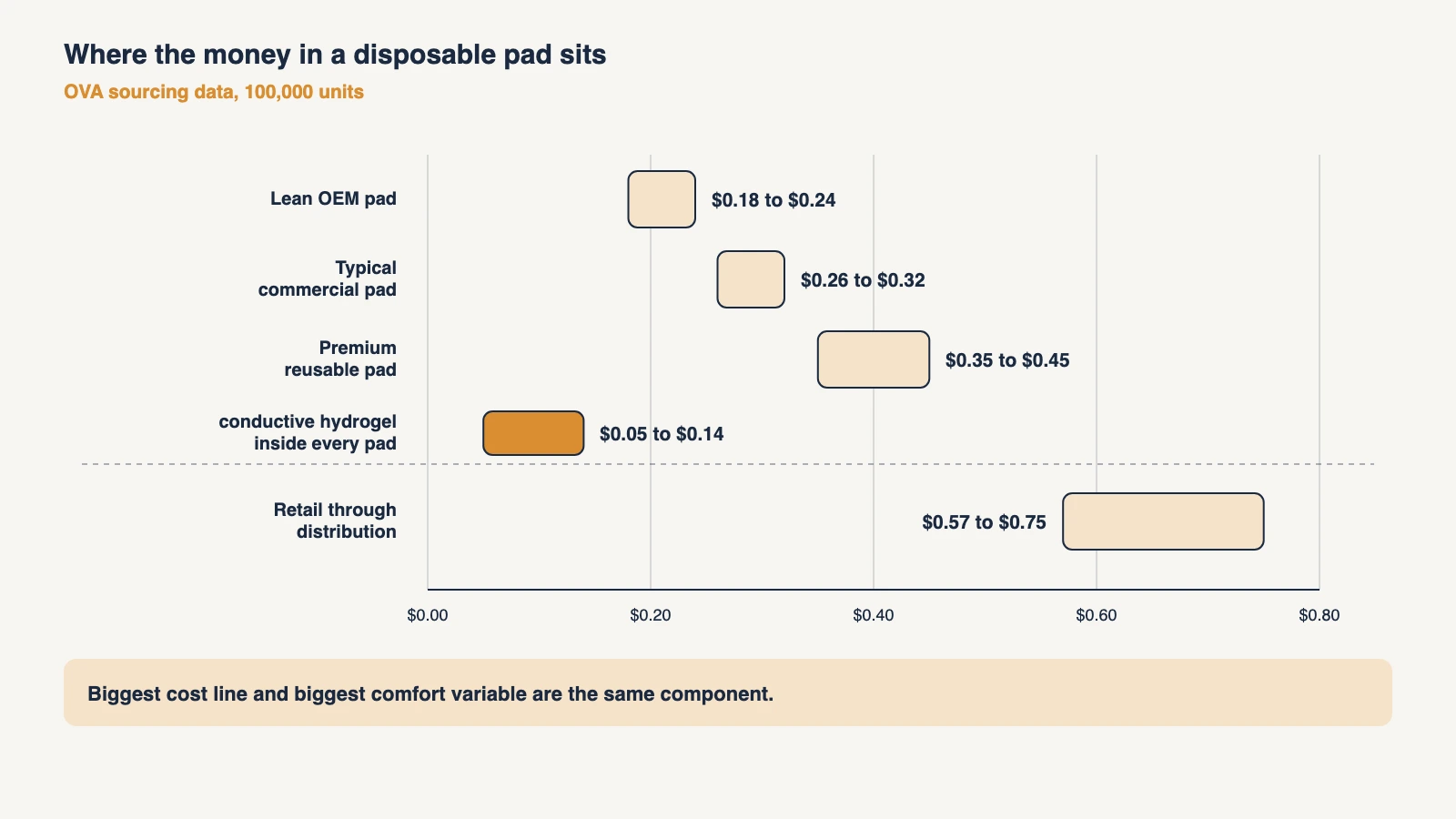
The practical reading for a program owner is that hydrogel formulation is simultaneously the biggest cost driver and the biggest comfort variable, which makes it the single component most worth dual-sourcing and qualifying before submission rather than after. A late hydrogel change is not a purchasing decision. It shifts impedance, adhesion, and skin response, and it can reopen both human factors and the clearance rationale.
The regulatory clock is not where this schedule is spent
For neuromuscular stimulators with a clean predicate, the 510(k) path is comparatively fast. FDA received Zynex’s M-Wave NMES submission on October 27, 2023 and issued a substantially equivalent decision on January 26, 2024, 91 days end to end. The FDA review clock itself is a 90 FDA-day goal once a submission is accepted, and the calendar stretches mainly through Additional Information cycles, where the submitter has up to 180 days to respond and the clock pauses.
Programs in this category routinely treat the 510(k) as the schedule anchor and plan around it. On this device class that is the wrong anchor. The longer poles are consumable process validation, biocompatibility on the skin-contact material, human factors work with the actual patient population, and building enough clinical comfort evidence that the therapy survives contact with home use.
The short version for a program director
Treat the consumable as the primary product and the electronics as its support system. Specify the output stage against aged electrode impedance, measure impedance in the device, and log it. Qualify a second hydrogel source before submission rather than after, because that component drives both cost and comfort. Test donning with the actual impaired population the device is indicated for, on production pads and production magnets. Plan the schedule around consumable validation and human factors rather than around a 510(k) that, with a clean predicate in this category, is likely to clear inside four months.
This program reached FDA clearance. The transferable lesson sits in the sequencing rather than in the outcome: on a device where the consumable determines both the therapy and the revenue, the consumable’s validation schedule should be the master schedule, and the submission date should be planned against it rather than the reverse.
Common questions
Why does a disposable electrode determine how a wearable stimulator performs?
Because stimulation is a charge delivery problem and the path from the output stage to the muscle runs through a hydrogel that changes while it is used. A fresh pad presents one impedance. The same pad after eight applications, partially dried, contaminated with skin oil, and peeled and reapplied several times, presents a substantially different one. The electronics either compensate for that drift or are defeated by it.
What goes wrong with a constant-voltage output stage?
The delivered dose falls as the pad ages, so the therapy quietly weakens and the patient reports that the device stopped working. The constant-current alternative holds the dose but raises compliance voltage into a drying pad, concentrating current in whatever contact area remains. That is a comfort and safety problem rather than an efficacy one, and both failure modes trace back to the same component.
How often do patients report pain during NMES?
A 2026 study by Wackendal and colleagues found that more than 20 percent of participants reported moderate to high pain, at or above 4 out of 10, during NMES even with a gel pad intervention intended to lower skin impedance. A 2024 study on electrical stimulation and skin vulnerability notes that approximately 40 percent of people who use transcutaneous electrical nerve stimulation develop skin contact dermatitis.
What should a stimulator measure in the field?
Electrode impedance, on every session. A stimulator that can tell the difference between a well-applied fresh pad and a dried pad at the end of its life can derate, warn, or refuse, and it converts an unattributable comfort complaint into a logged data point. On a Bluetooth-connected device with an app already in the system, that measurement also becomes adherence data the clinician can use.
Why does the hydrogel deserve a second qualified source?
Because it is simultaneously the biggest cost driver and the biggest comfort variable. In our sourcing at 100,000 unit volumes the conductive hydrogel runs roughly $0.05 to $0.14 inside a pad that lands between $0.18 and $0.45 depending on grade. A late hydrogel change shifts impedance, adhesion, and skin response at once, and it can reopen both human factors and the clearance rationale.
How long does 510(k) clearance take for a neuromuscular stimulator?
With a clean predicate it is comparatively fast. FDA received Zynex’s M-Wave NMES submission on October 27, 2023 and issued a substantially equivalent decision on January 26, 2024, 91 days end to end. The review clock is a 90 FDA-day goal once a submission is accepted, and the calendar stretches mainly through Additional Information cycles, where the submitter has up to 180 days to respond.
Sources: Wackendal et al., pain mitigation during NMES, 2026 · Almalty et al., electrical stimulation and skin vulnerability, 2024 · Burgess et al., NMES adherence systematic review, 2021 · FDA 510(k) record K233485, Zynex M-Wave · FDA, 510(k) submission process
Lisa Voronkova is a medical device development expert and CEO of OVA Solutions, an R&D firm of 62 engineers that has shipped over 200 devices. She holds a PhD in applied mathematics and wrote Hardware Bible: Build a Medical Device from Scratch.
If you are building something in this space, we are glad to look at it with you. Grab a slot on Lisa’s calendar at calendly.com/lisa-voronkova/30min, and if nothing there works, write to lisa@ovasolutions.com.