
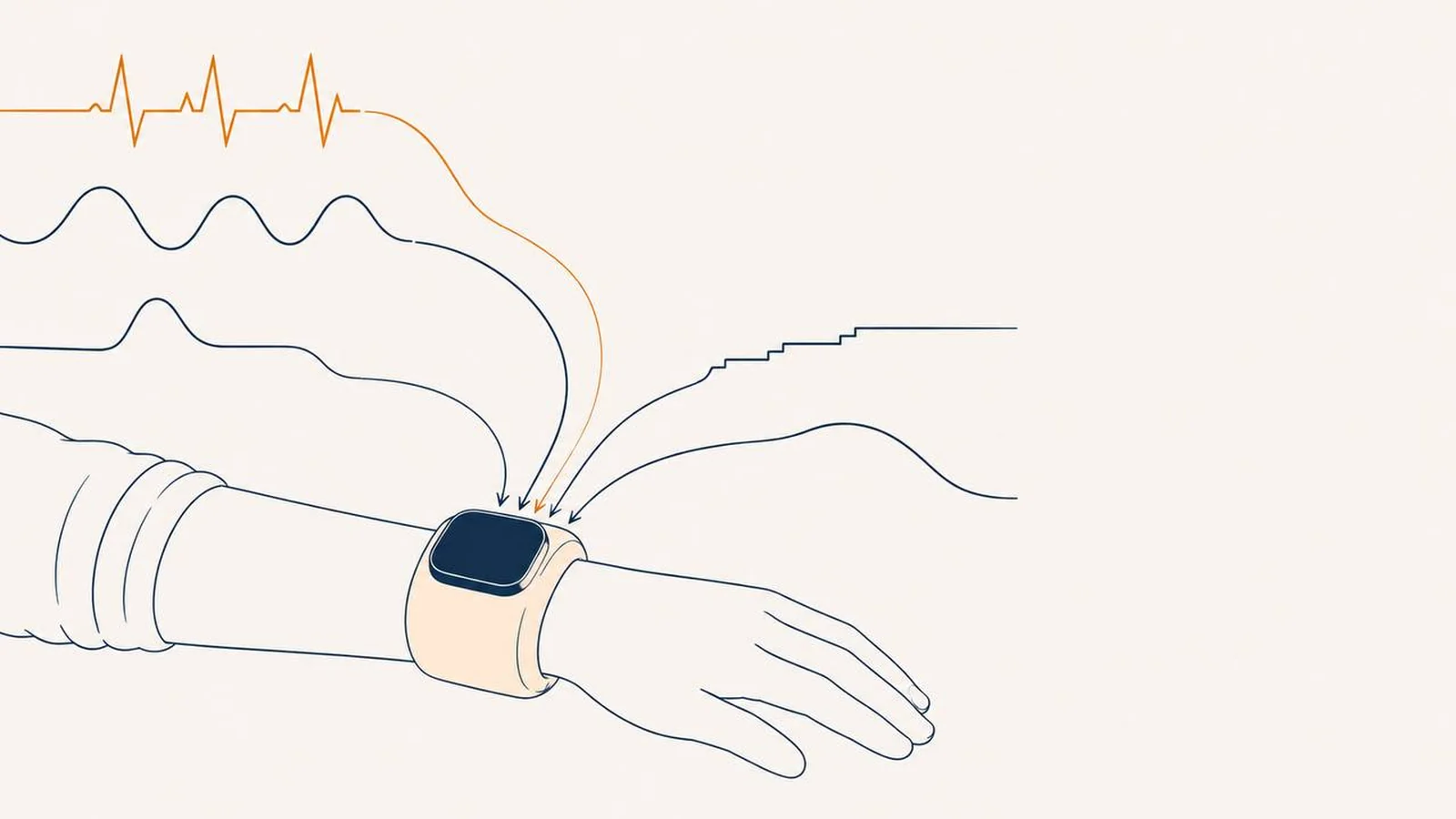
In short. We developed a wrist-worn remote patient monitor that measures blood pressure with a real inflatable cuff, plus ECG, oxygen saturation, pulse and skin temperature, and exchanges data with a server that can also configure the device remotely. Our scope ran from requirements to the assembly and quality control of the prototype units. In our testing blood pressure and pulse stayed within 5% of reference devices.
The challenge
On paper the device is five independent subsystems sharing a battery. In the enclosure they degrade each other. The cuff pump is a motor on the same chassis as an ECG front end that resolves microvolts and photodiodes that read the pulse wave. The processor with Wi-Fi active heats a small volume right next to the temperature sensor. And a requirement for a smartwatch-sized device with clinical blood pressure and a week of battery cannot be met with a cuff.
What we did
Build the interference matrix
Every sensor pair and what one does to the other under real conditions, before the block diagram.
Turn concurrency into a schedule
ECG and SpO2 are not sampled during cuff inflation; the 5 GHz radio transmits outside the ECG capture window; a settling delay protects the temperature reading.
Isolate heat mechanically
A thermal break between the compute stack and the sensor pod, with the temperature sensor on its own skin-contact island.
Choose Linux for integration, not for compute
Remote configuration, server-side data exchange and measurement applications updated separately from the firmware justified embedded Linux; the cost in runtime and heat should be written down in hours before committing.
What we would tell the next team
- The measurement schedule sets the duty cycle, the power budget, the cell and the enclosure. Fix it during architecture.
- Validate blood pressure against ISO 81060-2 (mean error within 5 mmHg, standard deviation 8 mmHg or less) on the real band and enclosure as early as a functional unit exists; the mechanics carry most of the variance.
- Write the runtime cost of an application processor in hours before you commit to it.
Full engineering note: Five vitals on one wrist: the interference problem in multi-parameter wearables.
So first one like signal not sensor. So the sensor is a cheap part. The hard part is getting a clean signal from the body.
Related pages
Building something similar?
Tell us what the device has to do. On a short call an engineer will walk you through the risks we saw on this project and how they apply to yours.
Sources
- Five vitals on one wrist: the interference problem in multi-parameter wearables
- OVA Solutions project records and portfolio, 2026
Client names are not disclosed. Updated on October 9, 2026.