
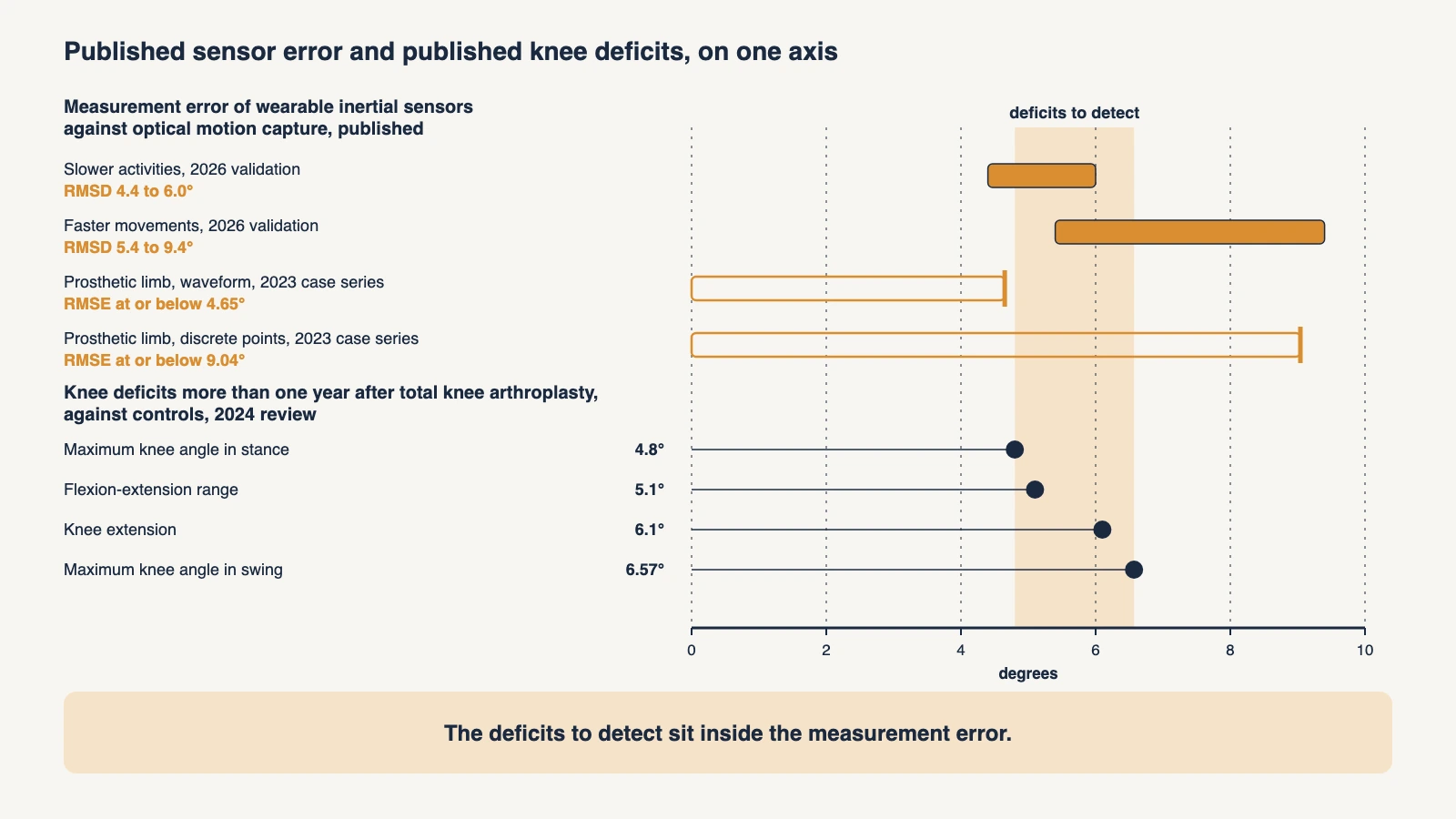
On a wearable knee monitor built on inertial sensors, published measurement error against optical motion capture runs 4 to 9 degrees, and the gait deficits it has to detect after total knee arthroplasty run 4.8 to 6.6 degrees. The defensible claim is change within one patient over weeks, not an absolute angle, with a flexion estimate independent of magnetic heading.
Two sets of published numbers define the design space for a wearable knee angle device, and they overlap almost exactly.
A 2026 validation of body-worn inertial sensors against marker-based and markerless optical motion capture reported knee flexion RMSD of 4.4 to 6.0 degrees for slower activities and 5.4 to 9.4 degrees for faster movements such as running, with correlation at or above 0.9. A 2023 case series with prosthesis users reported sagittal joint angle RMSE on the prosthetic limb at or below 4.65 degrees, with discrete point RMSE up to 9.04 degrees, and a single participant reaching 29.21 degrees because a microprocessor-controlled prosthetic knee interfered with the magnetometer.
Now the clinical signal. A 2024 systematic review of gait more than one year after total knee arthroplasty found a persistent knee extension deficit of about 6.1 degrees against controls, a flexion-extension range deficit of about 5.1 degrees, a maximum knee angle deficit of about 4.8 degrees in stance and 6.57 degrees in swing.
The deficits a knee monitor exists to detect are between 4.8 and 6.6 degrees. The measurement uncertainty of the sensing technology is between 4 and 9 degrees. Any product plan that does not confront that overlap directly is going to confront it later, during a validation study, at considerably greater expense.
The program described here was a wearable knee device measuring flexion angle and analyzing gait quality, built on an accelerometer, gyroscope, magnetometer, and Bluetooth link to a phone. OVA Solutions is an experienced medical device hardware developer with 62 engineers in house, covering electronics, firmware, mechanics and regulatory, and more than 200 devices shipped. On this program our scope covered PCB design and embedded software.
The way out is longitudinal, not absolute
Better sensors do not close this gap, because the dominant error terms are not sensor noise. The way out is to change what the device claims to measure.
Absolute goniometry asks the device to report a true joint angle, and there the 4 to 9 degree band applies in full. Within-subject longitudinal comparison asks a different question: how this patient’s angle at week eight compares to the same patient’s angle at week two, measured with the same device, on the same limb, with the same mounting.
Most of the error in the first case is systematic rather than random. Mounting offset, soft tissue geometry, and sensor alignment produce a bias that is roughly constant for a given patient and a given fitting, and a bias that is constant largely cancels when you subtract two measurements taken under the same conditions. Repeatability within a subject is substantially better than absolute accuracy against optical reference, which is why the useful claim is a trend and the unusable claim is a number.
That decision propagates through the whole program. It changes the intended use statement. It changes the validation study from a comparison against motion capture into a test-retest reliability design. It changes the algorithm from calibration-heavy absolute estimation toward drift-bounded relative tracking. And it changes the application from a display showing a degree value to a display showing a direction of travel over weeks.
Making that call at concept costs a week of argument. Making it after a failed validation study costs a year.
The magnetometer is sitting on a metal implant
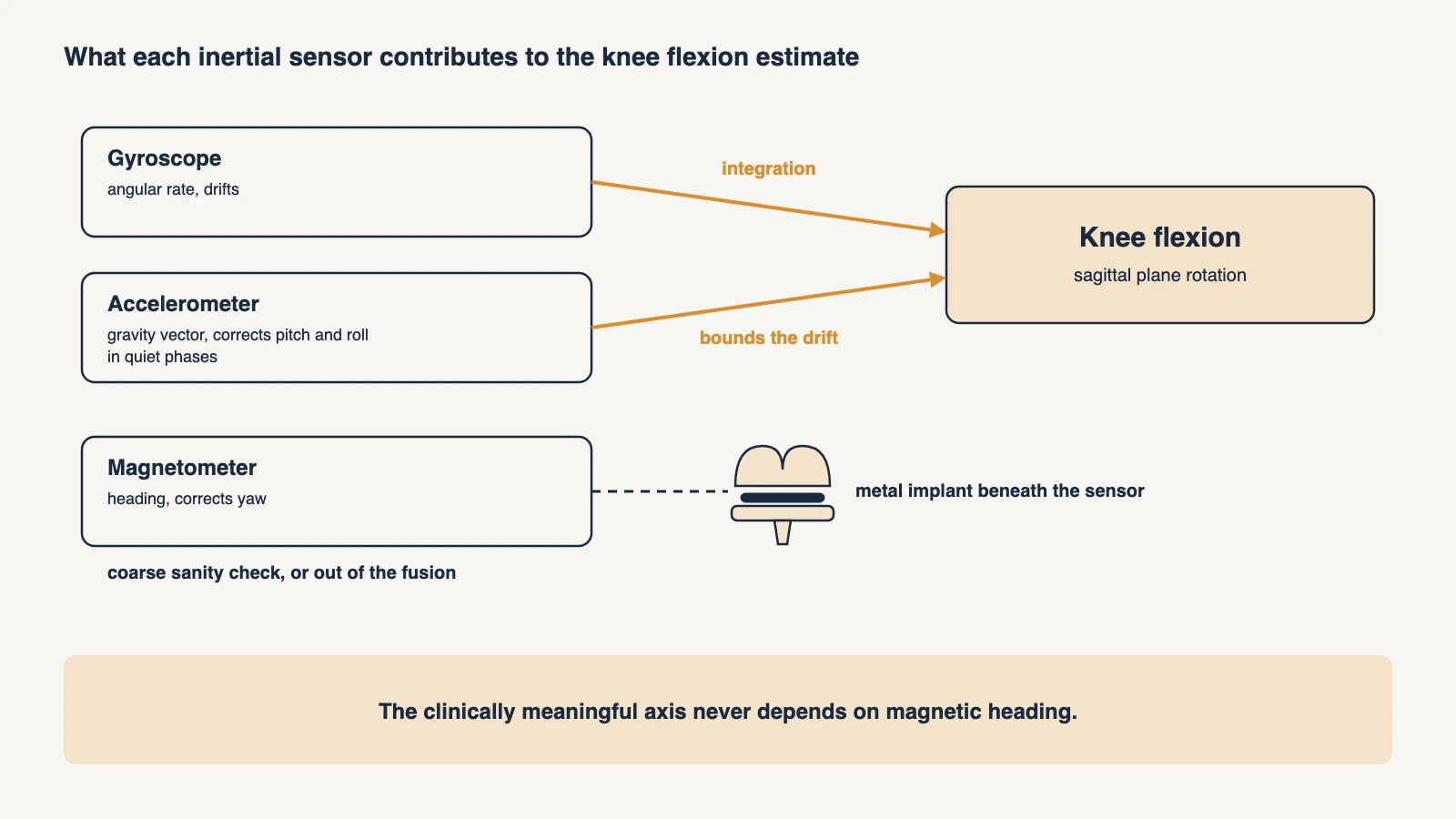
Standard inertial orientation estimation fuses three sensors. The gyroscope provides angular rate with drift. The accelerometer provides a gravity vector that corrects pitch and roll during quiet periods. The magnetometer provides a heading reference that corrects yaw, because gravity carries no yaw information.
On a knee monitor for arthroplasty patients, that third sensor is compromised by the population itself. A total knee prosthesis is a substantial mass of cobalt chromium and titanium alloy positioned directly under the device. Add the ferrous content of a rehabilitation gym, hospital beds, and door frames, and magnetic heading becomes unreliable in exactly the setting where the device is used.
The design response is to build the orientation estimate so it never depends on magnetic heading for the clinically meaningful axis. Knee flexion is a sagittal plane rotation, and it can be recovered from gyroscope integration bounded by gravity-vector correction during the quiet phases of gait, with the magnetometer demoted to a coarse sanity check or removed from the fusion entirely.
A 2019 validation in total hip arthroplasty patients points the same way from a different angle: knee flexion-extension agreed with optical tracking at an intraclass correlation of 0.83 to 0.86, while pelvic tilt measured on the same devices came in at 0.08. The axis you choose to claim matters more than the sensor you choose to buy.
The drift arithmetic supports doing this carefully, and the awkward part is that a consumer datasheet will not give you the number you need. TDK InvenSense specifies the ICM-42688-P at a rate noise spectral density of 0.0028 degrees per second per root hertz and an initial zero-rate output tolerance of plus or minus 0.5 degrees per second, with no bias instability figure anywhere in the document. The equivalent parts from Bosch, STMicroelectronics and NXP leave it out as well. Industrial modules do publish it, and the values are sobering: Analog Devices specifies the ADIS16505-3 at 4.9 to 8.1 degrees per hour of in-run bias stability depending on the axis. High-stability MEMS such as the TDK Tronics GYPRO4300 specify 0.4 degrees per hour typical and 2 degrees per hour maximum. The parameter that governs how fast an angle estimate walks away is the one a consumer part declines to state, which is why bias estimation during static periods, gravity-vector correction, motion-state gating, and periodic recalibration are not optional refinements. They are the architecture.
Mounting beats sensor selection
The device is strapped over skin and muscle that move relative to the femur and tibia. Soft tissue artifact is a larger error contributor in wearable gait measurement than sensor specification, and it is a mechanical problem rather than an electronic one.
The practical consequence is that strap design, cuff geometry, sensor placement relative to bony landmarks, and repeatability of donning deserve more engineering attention than the choice between one nine-axis part and another. A device that a patient can only fit correctly with clinical supervision has an accuracy specification that does not survive contact with home use, and every millimeter of donning variation shows up as degrees in the output.
This also argues for building donning verification into the device rather than into the instruction leaflet. A short guided posture at the start of a session, checked against expected sensor orientation, converts an invisible error source into a detectable one.
There is no threshold to anchor to, so use the ones that exist
A 2020 study attempting to establish minimal clinically important improvement for gait parameters after knee arthroplasty could not determine one from its data, which leaves the field without an established threshold to build a notification rule on. A 2025 study found many patients do not reach minimal detectable or clinically important improvement in knee biomechanics at all after surgery, and about one in five arthroplasty patients, 19 percent in Bourne’s series, remain unsatisfied with their outcome.
Building a notification rule on a threshold the literature has not established is a claim that will not survive review. What does exist is Patient Acceptable Symptom State data from the same 2020 work, which puts maximum knee flexion at 50 degrees and walking speed at 1.2 meters per second, alongside documented population deficits of about 0.18 meters per second in speed and 0.17 meters in stride length at six months to one year post surgery.
Those are defensible anchors. A device can report where a patient sits relative to an established acceptable symptom state and how that position is changing week over week, without asserting a clinical significance threshold that the field has not agreed on.
The short version for a program director
Compare your sensing error band against the effect size in the literature before the architecture is fixed, and when they overlap, move the claim from absolute measurement to within-subject longitudinal change.
Design the orientation estimate so the clinically meaningful axis never depends on magnetic heading, because the patient population carries a metal implant directly beneath the sensor.
Treat drift compensation as architecture rather than tuning, and budget bias estimation, gravity-vector correction, and motion-state gating from the start.
Spend more engineering effort on mounting repeatability than on sensor selection, and put donning verification in the device rather than in the manual.
Anchor notifications to published Patient Acceptable Symptom State values rather than to a minimal clinically important difference the literature has not established.
Common questions
Why can a wearable knee monitor not simply report the knee angle?
Because the published error and the published effect are the same size. A 2026 validation of body-worn inertial sensors against optical motion capture reported knee flexion RMSD of 4.4 to 6.0 degrees for slower activities and 5.4 to 9.4 degrees for faster movements such as running. A 2024 systematic review of gait more than one year after total knee arthroplasty found deficits of 4.8 to 6.57 degrees. An absolute angle cannot separate the two.
What should the device claim instead of an absolute angle?
Change within one patient over time. Most of the error is systematic: mounting offset, soft tissue geometry, and sensor alignment produce a bias that is roughly constant for a given patient and a given fitting, and a constant bias largely cancels when two measurements taken under the same conditions are subtracted. The useful claim is a trend between week two and week eight, and it turns the validation study into a test-retest reliability design.
Why is the magnetometer unreliable on a knee monitor for arthroplasty patients?
Because the population carries metal directly under the device. A total knee prosthesis is a substantial mass of cobalt chromium and titanium alloy, and rehabilitation gyms, hospital beds, and door frames add more ferrous content. In a 2023 case series with prosthesis users, one participant reached a discrete point RMSE of 29.21 degrees because a microprocessor-controlled prosthetic knee interfered with the magnetometer. Knee flexion is a sagittal plane rotation and does not need magnetic heading.
Why does a consumer inertial sensor datasheet not answer the drift question?
The parameter that governs drift is not in it. TDK InvenSense specifies the ICM-42688-P at a rate noise density of 0.0028 degrees per second per root hertz and an initial zero-rate output of plus or minus 0.5 degrees per second, and no bias instability. Industrial modules publish it: 4.9 to 8.1 degrees per hour depending on the axis for the ADIS16505-3, and 0.4 typical with 2 maximum for the GYPRO4300. Drift compensation is therefore architecture.
Why does mounting matter more than sensor selection?
Because the device is strapped over skin and muscle that move relative to the femur and tibia. Soft tissue artifact is a larger error contributor in wearable gait measurement than sensor specification, and every millimeter of donning variation shows up as degrees in the output. Strap design, cuff geometry, and placement relative to bony landmarks deserve the engineering attention, together with a short guided posture at session start that verifies donning in the device.
What can notifications be anchored to when no clinically important threshold exists?
To Patient Acceptable Symptom State values. A 2020 study could not determine a minimal clinically important improvement for gait parameters after knee arthroplasty from its data, but the same work puts the acceptable symptom state at 50 degrees of maximum knee flexion and 1.2 meters per second of walking speed. A device can report where a patient sits relative to those values and how that position changes week over week.
Sources: body-worn IMU knee tracking validation, 2026 · prosthesis user IMU validation case series, 2023 · total hip arthroplasty IMU validation, 2019 · long-term gait analysis systematic review after total knee arthroplasty, 2024 · congress abstract of the same review with pooled figures · walking speed and knee flexion Patient Acceptable Symptom State study, 2020 · gait biomechanics improvement study, 2025 · Bourne et al., patient satisfaction after total knee arthroplasty, 2010 · TDK InvenSense ICM-42688-P datasheet · Analog Devices ADIS16505 datasheet · TDK Tronics GYPRO4300 specification
Lisa Voronkova is a medical device development expert and CEO of OVA Solutions, an R&D firm of 62 engineers that has shipped over 200 devices. She holds a PhD in applied mathematics and wrote Hardware Bible: Build a Medical Device from Scratch.
If you are building something in this space, we are glad to look at it with you. Grab a slot on Lisa’s calendar at calendly.com/lisa-voronkova/30min, and if nothing there works, write to lisa@ovasolutions.com.
More on this topic: Orthopedics & Rehabilitation