
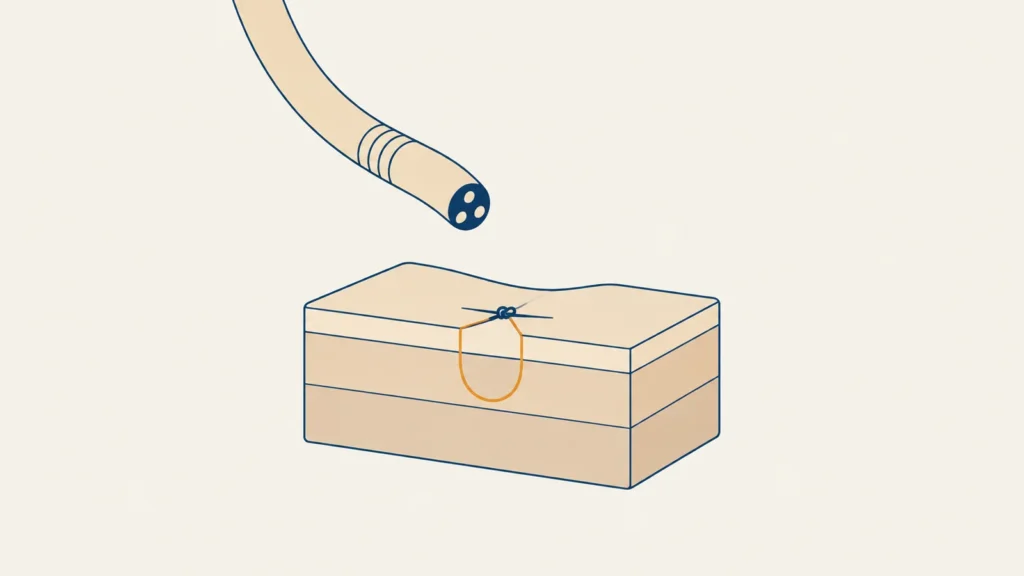
Endoscopic suturing places its sutures as intended in nearly every published series, yet clinical success runs from 93 percent for perforations down to 27 percent for anastomotic leaks. The tissue decides that gap: the submucosa carries the load. So the device is specified by needle depth and by tip force under articulation, and mechanism work targets procedure time.
The published outcome data for endoscopic suturing contains a divergence that should shape every engineering decision in the category, and it is easy to miss because the two numbers are usually reported in the same sentence.
Technical success, meaning the device placed the sutures as intended, is consistently excellent. A 2024 pooled meta-analysis by Vongsavath and colleagues covering closure after endoscopic submucosal dissection reported 99.2 percent technical success, defined as using the device without malfunction. Maselli and colleagues reported 99.3 percent across a prospective European registry of 137 patients in 2022. Sharaiha and colleagues reported 97.5 percent in a 2016 multicenter series. A UK upper gastrointestinal series published in 2025 reported 88.1 percent technical success and 91.9 percent immediate clinical success.
Clinical success, meaning the defect actually stayed closed and the patient healed, splits by indication in a way the technical number completely conceals. The same meta-analysis, seven studies and 134 patients, pooled the efficacy of instrument use, defined as achieving closure of the defect after endoscopic submucosal dissection, at 95.8 percent. Sharaiha’s multicenter data reported 93 percent for perforations, 91.4 percent for stent anchorage, 80 percent for fistulas, and 27 percent for anastomotic leak closure. A 2022 series on chronic gastrointestinal fistulas, most of them esophagotracheal, closed every fistula at the procedure, and 25 percent stayed closed at three months. Two other series show the same pattern: Maselli’s registry reported clinical success of 94.7 percent for perforations and 64.7 percent for leaks and fistulas, and the UK series reported 69.6 percent long-term clinical success.
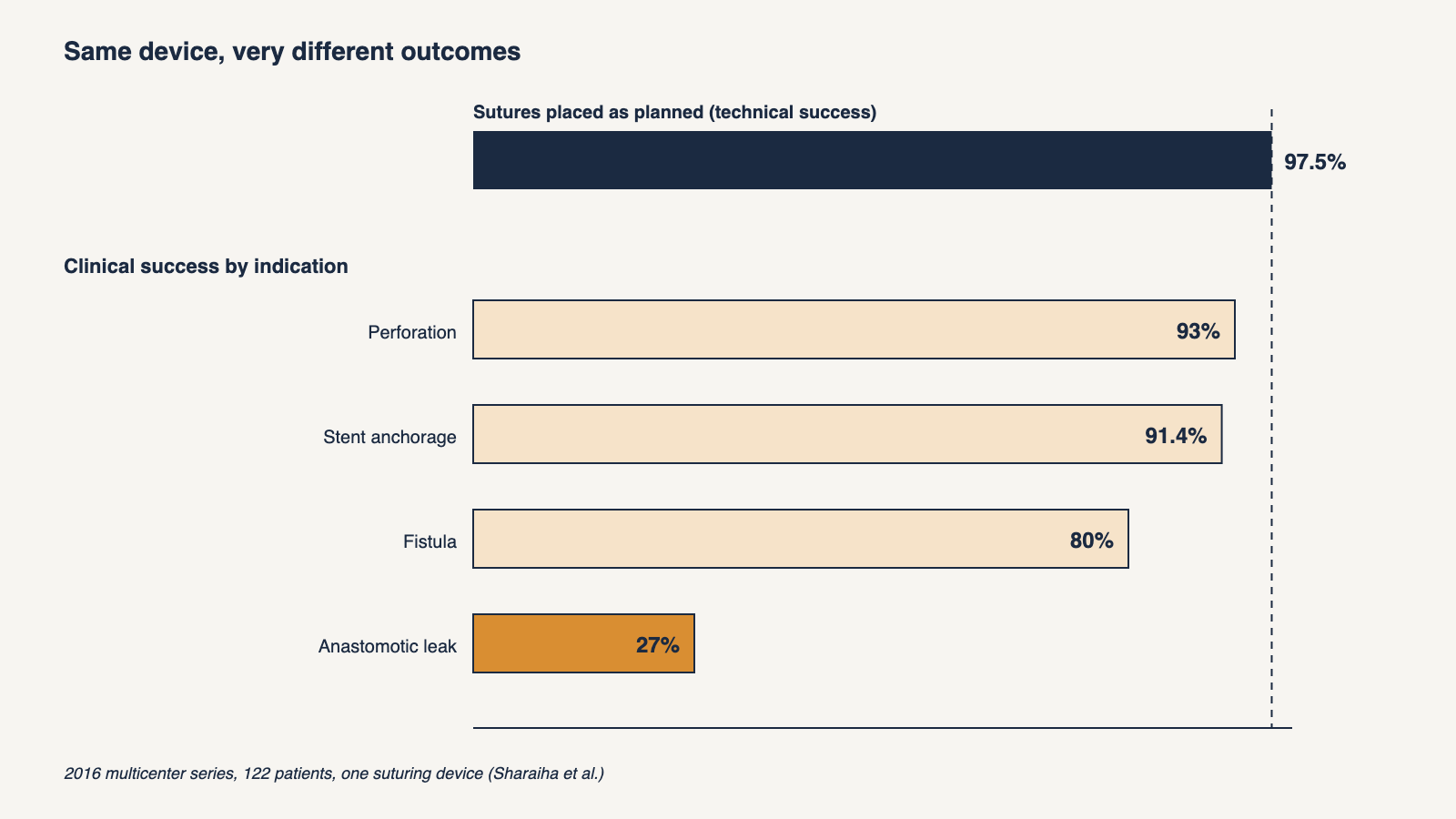
One device, one mechanism, technical performance near 99 percent, and clinical outcomes ranging from 93 percent down to 25. The mechanism is not the variable.
The program described here was a minimally invasive suturing system for full-thickness tissue approximation in the gastrointestinal tract through a flexible endoscope, intended for closure of perforations, fistulas, and leaks. Programs like this one are handled by experienced medical device hardware developers. At OVA Solutions that means 62 engineers and over 200 shipped devices. On this program our scope covered requirements, concept, industrial and mechanical design, prototyping, and quality control, with 3D scanning used to work against real endoscope geometry.
The gap lives in the submucosa
The mechanical explanation for that divergence is well established and rarely translated into a device specification.
A 2002 study of human intestinal layers identified the submucosa as the key contributor to anastomotic and suture holding strength. The layer that carries load is not the mucosa the endoscopist can see and not the serosa on the far side. It is a specific layer in the middle, and a suture that does not capture it is mechanically a decoration.
The force numbers follow from that. Tera’s classic 1976 work put single through-and-through suture holding power in the alimentary tract at 1.02 to 2.54 kiloponds, roughly 10 to 25 newtons, with stomach and colon highest and esophagus and sigmoid colon lowest. A 2023 ex vivo porcine study by Matsui and colleagues pulled on gastric closures until they began to open: an endoscopic purse-string made with a detachable loop and clips held 3.7 to 5.2 newtons, an over-the-scope clip about 18 to 19, and a hand-sewn surgical closure 62.4. None of these closures used a suturing device, but the spread shows how far endoscopic closure sits below an open surgical stitch.
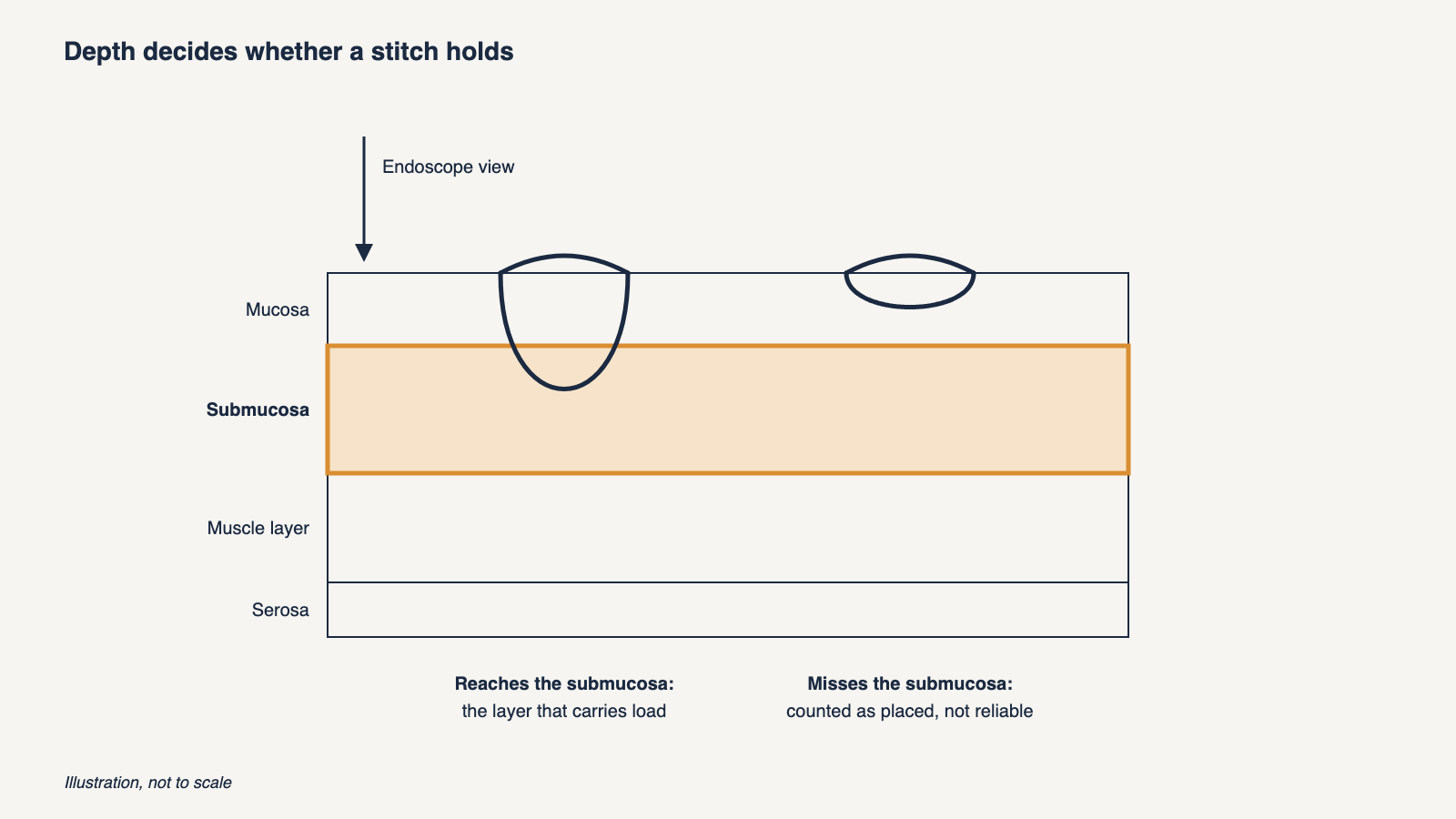
So the design target is not a force figure. It is depth control. Tera’s figures, 10 to 25 newtons per suture, belong to stitches that take the whole wall. A stitch placed shallow can look the same on video, records as technical success, and can still let the defect open later. That is precisely the mechanism by which a 99 percent technical number sits alongside a 27 percent clinical one.
The engineering requirement that follows is that the device must guarantee needle depth through a flexible scope at an approach angle the operator did not choose and cannot fully control. Depth is the specification. Force is downstream of it.
Specify at the tip, not at the handle
Force applied at the handle does not arrive at the needle. It arrives reduced by friction and articulation along a scope that has been threaded through the esophagus, curved through the stomach, and in many of the relevant cases retroflexed to reach the target.
The available tip force is therefore a function of the scope’s current geometry, which the operator changes continuously throughout the procedure. And the worst case for transmission, full retroflexion, is the same configuration needed to reach the fundus and cardia, where several of the important indications live.
That has a direct consequence for how requirements are written. A specification stating needle force at the handle is not a specification. The number has to be stated at the tip, under worst-case articulation, and verified in a bench fixture that reproduces realistic scope paths rather than a straight one. Working from 3D scans of actual endoscope geometry rather than from nominal drawings is the difference between a bench result that predicts clinical behavior and one that flatters the design.
Tissue tolerance sets the ceiling, and it moves by segment
There is an upper bound as well as a lower one. A 2012 porcine study by Rodrigues and colleagues pulled on single sutures in different organs and found that small bowel tolerates roughly 1.5 times the traction of large bowel before tissue damage, and that maximum acceptable traction varies widely by tissue type.
Combined with Tera’s finding that holding power is lowest in the esophagus and sigmoid colon, the working window between capturing submucosa reliably and damaging tissue is not a constant along the tract.
A single device covering the entire gastrointestinal tract is therefore a compromise across several different mechanical windows, and the honest engineering response is to decide which segments the design is optimized for and to let the indication statement say so. Choosing the indication is an engineering decision made at concept, not a regulatory decision made at the end.
Mechanism engineering pays in time, not in success rate
None of the above means mechanism work has low value. It means the value shows up in a different metric.
A 2016 expert interview noted that for a perforation in the right colon or deeper in the duodenum, a suturing system or an over-the-scope clip could take at least 10 minutes to close it.
Technical success is already at 99 percent and has no meaningful room left. Procedure time does. Reload cycles, needle exchange, suture management, and the number of hand motions required per stitch are all mechanism problems, they are all measurable on the bench, and they translate directly into the value proposition that justifies the device.
That is where mechanical engineering hours return the most on this device class, and it is a cleaner target than chasing a success rate that the tissue, not the tool, is determining.
The short version for a program director
Separate technical success from clinical success in the product requirements, and recognize that published clinical outcomes in this category range from 93 percent to 25 percent on the same mechanism.
Specify suture depth rather than suture force, because the submucosa carries the load and a shallow stitch can record as a success and still fail.
State tip force under worst-case articulation, verify it on scope paths taken from 3D scans of real endoscopes, and treat any handle-referenced number as unverified.
Decide which gastrointestinal segments the mechanical window is optimized for during concept, and write the indication to match rather than claiming the whole tract.
Direct mechanism engineering at procedure time, where measurable gains remain.
Common questions
What is the difference between technical and clinical success in endoscopic suturing?
Technical success means the device placed the sutures as intended. Clinical success means the defect stayed closed and the patient recovered. In a 2016 multicenter series of 122 patients treated with one suturing device, technical success was 97.5 percent, while clinical success was 93 percent for perforations, 91.4 percent for stent anchorage, 80 percent for fistulas and 27 percent for anastomotic leaks.
Why does suture depth matter more than suture force?
Because the submucosa carries the load. Tensile testing of human intestine published in 2002 found that only the submucosa gives an anastomosis meaningful strength, and that sutures which miss it are unreliable. A shallow stitch can look the same on video and still be recorded as a technical success. Depth is the requirement to specify and verify, and holding force follows from reaching the right layer.
Why should needle force be specified at the tip of a flexible endoscope?
Force applied at the handle is reduced by friction and articulation along the scope, and the loss changes as the operator moves it. Full retroflexion, needed to reach the fundus and cardia, is the worst case for transmission. A useful requirement states needle force at the tip under worst-case articulation and verifies it on a bench fixture that reproduces realistic scope paths, such as paths taken from 3D scans of real endoscopes.
Can one endoscopic suturing device be optimized for the whole gastrointestinal tract?
Rarely. Tera’s 1976 measurements put single-suture holding power at 1.02 to 2.54 kiloponds, about 10 to 25 newtons, lowest in the esophagus and sigmoid colon and highest in the stomach and colon. A 2012 porcine study found that small bowel tolerates about 1.5 times the suture traction of large bowel before damage. The working window moves by segment, so the target segments belong in the concept phase.
Where does mechanism engineering add the most value on an endoscopic suturing system?
In procedure time. Technical success already sits near the ceiling in most published series. A 2016 expert interview noted that a perforation in the right colon or deeper in the duodenum could take at least 10 minutes to close with a suturing system or an over-the-scope clip. Reload cycles, needle exchange, suture management and hand motions per stitch are all mechanism problems, and all of them can be measured on the bench.
How strong are endoscopic closures compared with hand-sewn surgical closures?
Much weaker in published bench data. In a 2023 ex vivo porcine study, closures pulled until they began to open held 3.7 to 5.2 newtons for an endoscopic purse-string made with a loop and clips, about 18 to 19 newtons for an over-the-scope clip and 62.4 newtons for a hand-sewn closure. None of those closures used a suturing device, so the numbers frame the gap rather than measure a suturing system.
Sources: Vongsavath et al., pooled meta-analysis of post-ESD endoscopic suturing, 2024 · Maselli et al., European OverStitch registry, 2022 · Sharaiha et al., multicenter endoscopic suturing series, 2016 · UK upper gastrointestinal OverStitch case series, 2025 · chronic gastrointestinal fistula endosuturing series, 2022 · expert interview on endoscopic perforation management, 2016 · Tera, tissue holding power study, 1976 · Egorov et al., intestinal layer mechanical strength study, 2002 · Matsui et al., purse-string versus over-the-scope clip closure, ex vivo porcine, 2023 · Rodrigues et al., suture traction and tissue damage, porcine, 2012
Lisa Voronkova is a medical device development expert and CEO of OVA Solutions, an R&D firm of 62 engineers that has shipped over 200 devices. She holds a PhD in applied mathematics and wrote Hardware Bible: Build a Medical Device from Scratch.
If you are building something in this space, we are glad to look at it with you. Grab a slot on Lisa’s calendar at lisavoronkova.com/booking, and if nothing there works, write to lisa@ovasolutions.com.
More on this topic: Prototyping & Product Development