
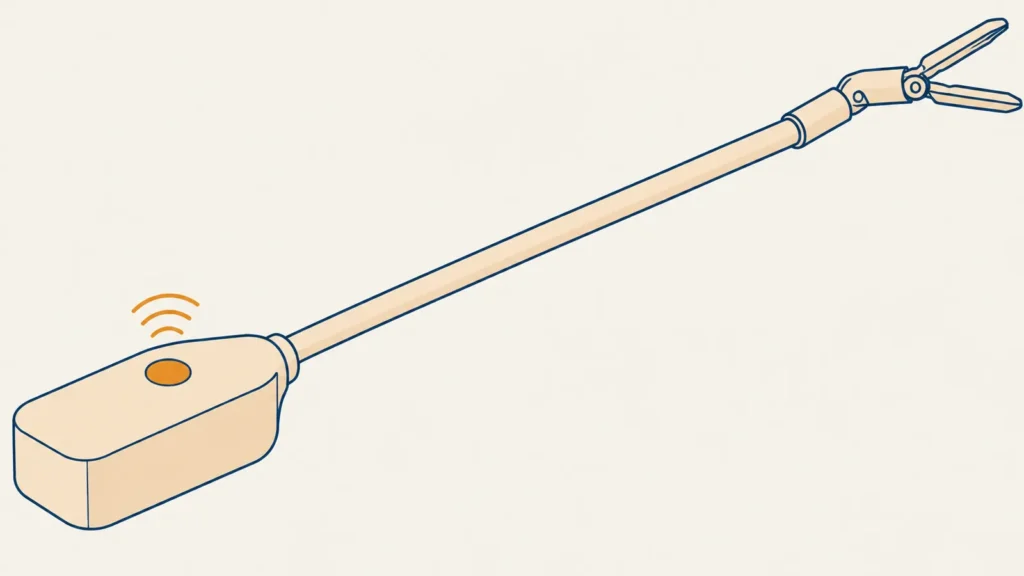
The subsystem that recognizes which instrument is attached to a surgical robot does three jobs: it enforces a use limit, it selects motion and force limits, and it can record wear. Use count is a weak proxy for wear, a safety interlock should not simply fail closed mid-procedure, and the recoverable minutes sit in setup rather than in instrument exchange.
On a surgical robot, the subsystem that recognizes which instrument is attached looks like a minor piece of embedded engineering. It is a reader, a tag, and a lookup. In practice it carries three unrelated jobs simultaneously, and most implementations are designed well for one of them and by accident for the other two.
The program described here was a medical robot intended for procedures across abdominal, thoracic, and gynecological surgery, built with an ESP32-C2, an NFC reader, and FreeRTOS. At OVA Solutions we are experienced medical device hardware developers, with 62 engineers and more than 200 devices shipped. On this program our scope covered requirements, concept, product and industrial design, PCB and mechanical design, embedded software, and quality control. What follows is how we would approach instrument identification on a robot of this kind.
Use count is a poor proxy for wear
The established approach in this market is a fixed number of uses per instrument. Standard da Vinci X and Xi instruments carried a 10-use limit before Intuitive’s Extended Use Program in 2020. In the company’s January 2026 US catalog, reusable 8 mm X and Xi instruments are rated for 10 to 18 uses, and a number of common ones are still at 10.
A 2026 single-center retrospective study undermines the technical premise of the count. Of 757 reusable robotic forceps used in 1,906 operations from 2022 to 2024, 148, or 19.6 percent, failed before reaching their usage limit, an unreimbursed loss of 75,950 US dollars over three years, approximately 39.8 dollars per surgery.
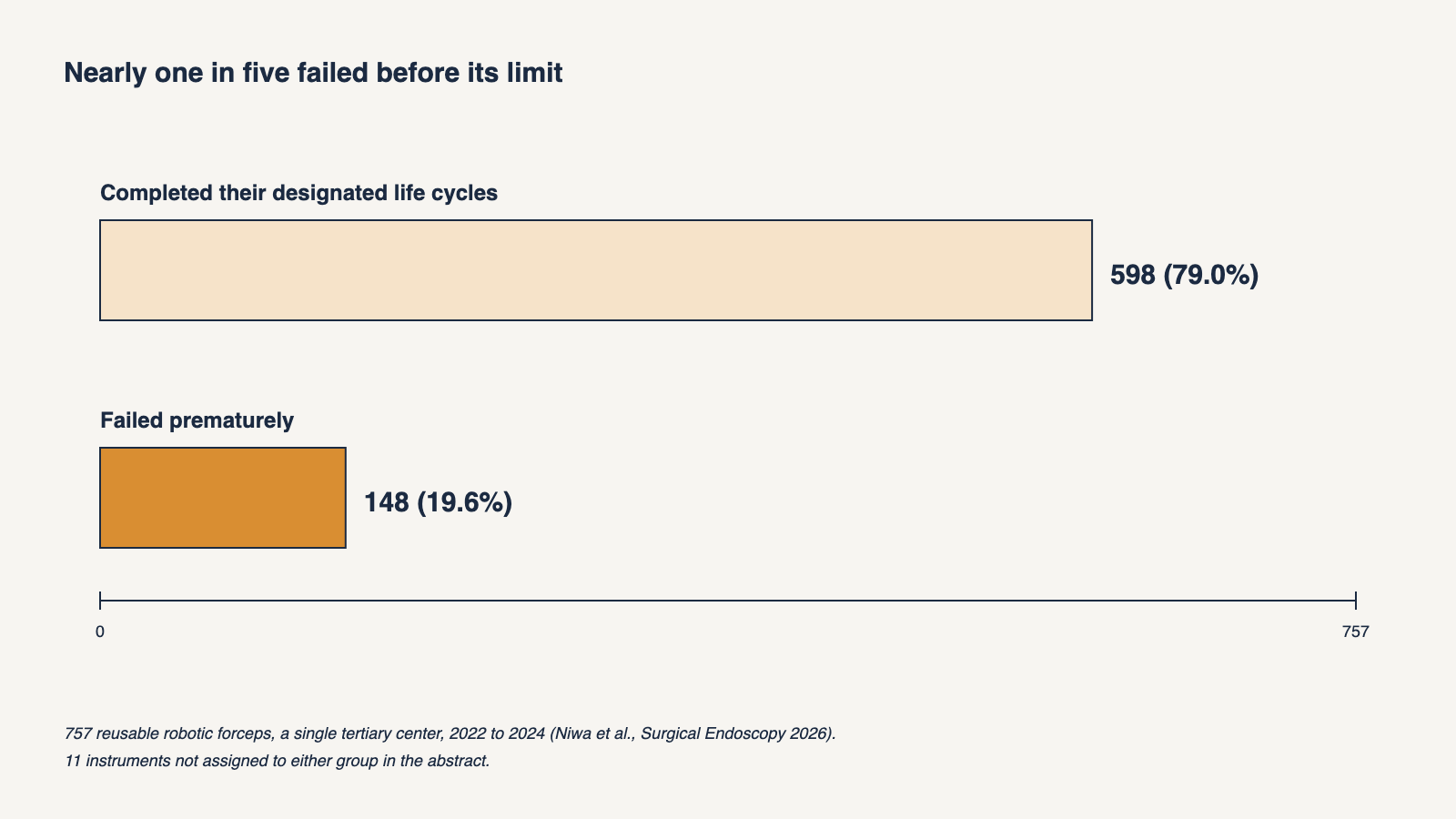
That result is worth taking seriously as an engineering finding rather than as a procurement complaint. A count assumes wear accumulates as a function of how many times an instrument was installed. Wear actually accumulates as a function of what the instrument did: cumulative actuation cycles, peak forces applied, tissue engaged, cable tension history, autoclave exposure, and how many reprocessing cycles it survived. Two instruments at use number seven can be in entirely different mechanical condition.
We would store a usage record rather than a usage count. An NFC tag with writable memory can hold cumulative actuation cycles, peak measured force, reprocessing count, and thermal exposure, written back by the robot at the end of each case. Retirement then becomes condition-based rather than count-based, which converts a proportion of those early failures into predictable, scheduled retirements.
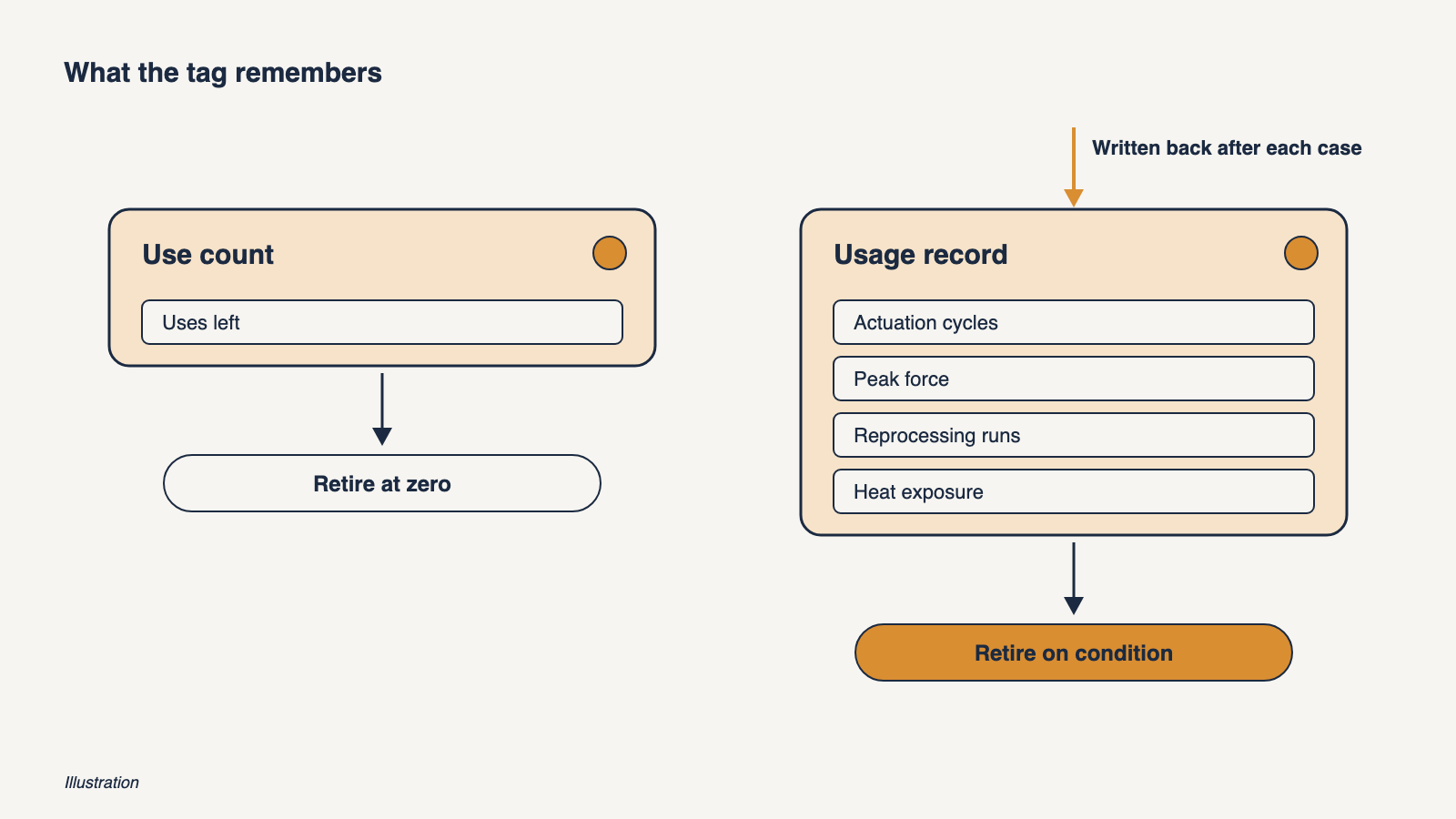
The change also helps the hospital. Each retirement then has a documented cause that its clinical engineering staff can review.
Commercial interlocks and safety interlocks fail differently
The same subsystem enforces a commercial limit and gates a safety-relevant behavior, because the robot must know what is attached in order to know which motions and force limits are permitted. Those two roles have opposite failure preferences.
A commercial interlock can fail closed. If the tag cannot be read while the instrument is being fitted before the case starts, turning it away costs a few minutes and puts no one at risk.
A safety interlock during a procedure cannot simply inherit that logic. A tag that stops reading in the middle of a long case, with instruments inside the patient, creates a hazard of its own if the robot then refuses to proceed. We would conduct the failure mode analysis from the patient’s position rather than from the manufacturer’s. In many architectures the safer outcome is a degraded mode with conservative force and motion limits, full logging, and a clear indication to the surgical team rather than a hard refusal, and the final decision belongs to the hazard analysis of the specific system.
Writing that requirement down early matters, because the default implementation of a reader is fail closed, and it takes deliberate effort to make an exception that is safe, auditable, and not exploitable.
Multi-specialty platforms depend on the identification layer
A robot covering abdominal, thoracic, and gynecological procedures is carrying three instrument families with different reach, articulation, and force envelopes, used in three sterile field geometries.
The identification layer is what makes that tractable. The control system cannot apply a single motion and force policy across all of it, so instrument recognition stops being an accessory feature and becomes the mechanism by which the platform knows which policy to load. Treating it as a peripheral during architecture leads to a system where adding a fourth specialty requires touching the motion controller, which is the part of the system with the most expensive verification burden.
We would keep instrument-specific limits as data attached to the instrument rather than as logic embedded in the controller, so extending the platform is a data operation rather than a firmware change to a safety-critical component.
Instrument swap time is a rounding error
There is a persistent instinct in robotic surgery engineering to optimize the instrument exchange mechanism, because it is visible, satisfying, and easy to measure. The operating room data does not support it as a priority.
The seconds-level exchange figures we found come from lab bench work on an automated carousel for modular shafts: a 60 second manual target and 84 seconds on average for the automated system. Meanwhile a prospective study of 30 robotic urology cases, published in 2021, put mean total operating room time at 320.86 minutes, with a range from 172 to 485. Console time accounted for just under half of that and non-operative time for close to a third.
Docking on a da Vinci Xi runs about 6.9 minutes after the learning curve, and published figures across systems and centres span 4 to 29 minutes, partly because studies start and stop the clock at different points. Even the slow end of that is under 10 percent of a 320 minute case.
So an engineering hour spent shaving three seconds off an exchange competes against an engineering hour spent removing two minutes from draping. The second one is worth roughly forty times more per case.
The learning curve data points to where that time is recoverable. Docking in one gynecology program took 12.6 minutes in its first year and 5.5 minutes in its third. Early implementation of the Dexter system in 2024 reported a median docking time of 6 minutes across a 2 to 16 minute range, improving to 4 minutes by the final tertile of cases.
In both series the times came down as the teams accumulated cases. Design for learnability can bring part of that gain forward to the first case rather than month six. Fewer setup steps, unambiguous port and arm positioning, physical constraints that prevent incorrect assembly, and clear feedback when a step has completed correctly all convert a training gain into a design gain.
The short version for a program director
Store a usage record on the instrument rather than a usage count, because in one single-center study 19.6 percent of reusable robotic forceps failed before reaching their nominal limit and count is a weak proxy for condition.
Separate the commercial interlock from the safety interlock in the requirements, run the failure mode analysis from the patient’s position, and let the hazard analysis decide what happens when a tag cannot be read mid-procedure, with a logged degraded mode as the usual candidate.
Keep instrument-specific motion and force limits as data attached to the instrument rather than as logic inside the motion controller, so adding a specialty does not reopen verification on a safety-critical component.
Direct time optimization at draping and docking rather than at instrument exchange, since docking alone runs minutes against an exchange measured in seconds.
Treat learnability as a schedule lever, because docking times in published series fall substantially as teams accumulate cases, and design can capture part of that gain from the first case.
Common questions
Why is a use count a weak measure of surgical instrument wear?
Because a count treats every use the same, while wear depends on what the instrument did. In a 2026 Surgical Endoscopy analysis from one hospital, covering 2022 to 2024, 148 of 757 reusable robotic forceps (19.6 percent) broke down before their designated life cycle was used up, across 1,906 robotic operations. The unreimbursed cost was about 75,950 US dollars, roughly 40 dollars per surgery.
What should an instrument tag store instead of a use count?
A usage record. Writable tag memory can keep a running total of actuation cycles along with the highest force measured, the number of reprocessing runs and the heat exposure, with the robot updating it after every case. Retirement can then follow the instrument’s condition rather than a fixed number, which turns a share of unexpected failures into planned retirements. The record also gives the hospital a reason for each retirement that it can check.
Should a robot refuse an instrument whose tag cannot be read?
Not always. A commercial check can fail closed, because refusing an unread instrument before a case harms no one. During a procedure, a hard refusal with instruments already in the patient can create a hazard of its own. The failure mode analysis should be run from the patient’s position, and in many architectures it favors a reduced-capability mode with tighter limits, logging and a visible alert, with the final call left to hazard analysis.
How does instrument identification help a multi-specialty surgical robot?
Abdominal, thoracic and gynecological instruments differ in reach, articulation and force envelope, so one motion and force policy cannot cover them all. Instrument recognition tells the controller which policy to load. When per-instrument limits travel with the instrument as data, instead of being coded into the motion controller, adding a specialty becomes a data change instead of a change to the most expensive part of the system to verify.
Is instrument exchange time worth optimizing on a surgical robot?
Usually less than setup. The seconds-level exchange figures we found come from lab bench work on modular shafts: a 60 second manual target and 84 seconds on average for an automated carousel. In a prospective study of 30 robotic urology cases, mean total operating room time was 320.86 minutes. Docking alone on a da Vinci Xi took 6.9 minutes after the learning curve, and published docking times range from 4 to 29 minutes.
How much does robot docking time improve as a team gains experience?
Substantially. A gynecology service that tracked its own times saw docking drop from 12.6 minutes in year one to 5.5 minutes in year three. With the Dexter system, the first 56 procedures at one center had a median docking time of 6 minutes, range 2 to 16, and the final third of those cases came down to 4. Fewer setup steps, unambiguous arm positioning and clear feedback can let a team reach those times sooner.
Sources: Intuitive Surgical, Extended Use Program notice, 2020 · Intuitive Surgical, da Vinci X/Xi instruments and accessories catalog, 2026 · single-center retrospective of reusable robotic instrument durability and costs, 2026 · prospective study of operating room time in 30 robotic urology cases, 2021 · da Vinci Xi draping and docking times, 2020 · reported docking time ranges across systems, 2024 · robotic gynecology operating and docking times over the years, 2021 · Dexter robot early implementation study, 2024 · automated carousel exchange of modular instrument shafts, bench study, 2026
Lisa Voronkova is a medical device development expert and CEO of OVA Solutions, an R&D firm of 62 engineers that has shipped over 200 devices. She holds a PhD in applied mathematics and wrote Hardware Bible: Build a Medical Device from Scratch.
If you are building something in this space, we are glad to look at it with you. Grab a slot on Lisa’s calendar at lisavoronkova.com/booking, and if nothing there works, write to lisa@ovasolutions.com.
More on this topic: Prototyping & Product Development