
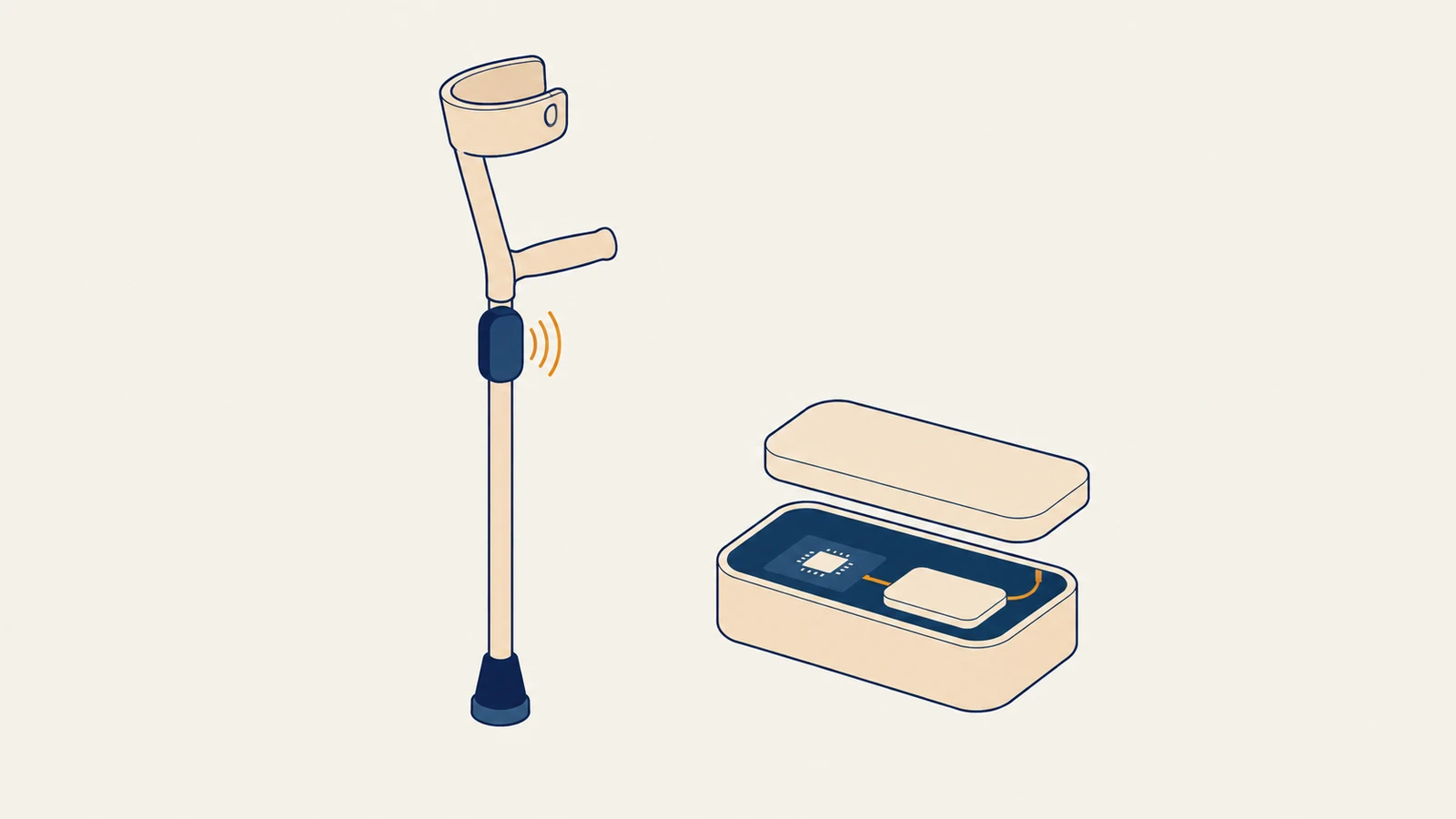
In short. We developed a device that doses crutch loading during rehabilitation, so patients can increase the load on the limb gradually and clinicians can see how it is going. The program covered everything from requirements to production and quality control: custom force sensors, finite element analysis, an nRF52 with Bluetooth, a low-power battery design and an injection-molded housing. It took two phases over eight months and about 1,660 engineering hours, and ended with 100 pairs produced.
The challenge
Partial weight bearing after lower-extremity surgery is one of the least followed instructions in rehabilitation: published compliance is 37.5% after lower-extremity surgery, 22% in patients 65 and over with femur or pelvic fractures and close to zero on the first days after knee replacement. Measuring load is the easy part; published accuracy is already near an intraclass correlation of 0.97. The device has to change behavior.
What we did
Sensors and electronics
Custom force sensors developed for the device, an accelerometer, an nRF52 for BLE and a low-power battery design.
Mechanics
Finite element analysis of the load path, then early prototypes 3D printed in several materials.
Tooling and durability
Housings moved to aluminum molds and passed durability tests before the production run.
Production
100 pairs produced with quality control.
What this program taught us
- A crutch measures load through the crutch, not through the limb. Write the claim against what is measured and validate across gait patterns, not standing on a force plate.
- Feedback must land inside the step. After the step it is a report; during loading it is a correction. Visual feedback during walking is a fall risk for elderly patients; haptic feedback performs better in published studies.
- The volume forecast decides the housing cost. In our cost modeling a molded medical housing costs $0.51 to $2.45 per unit at 10,000 a year and $0.33 to $1.35 at 50,000, and tooling runs $3,000 to $100,000.
Full engineering note: Load sensing is solved. Adherence is the product..
In the clinic you get a snapshot like a single frame. The patient walks in they’re nervous. They’re on their best behavior and you measure them for a couple of minutes. But the real recovery doesn’t happen in this frame. So it happens in the other 167 hours at home when no one is watching.
Related pages
Building something similar?
Tell us what the device has to do. On a short call an engineer will walk you through the risks we saw on this project and how they apply to yours.
Sources
- Load sensing is solved. Adherence is the product.
- OVA Solutions blog: crutch prototypes from 3D printing to aluminum molds
- OVA Solutions project records, 2020 to 2022
Client names are not disclosed. Updated on October 9, 2026.