
The short answer. Orthopedics is one of the main areas of OVA Solutions: rehabilitation aids, range-of-motion and gait monitors, post-operative therapy devices, powered rehabilitation equipment and surgical fixation tools. We produced 100 pairs of a load-sensing rehabilitation crutch, took a cold therapy device from concept to clinical trials in 12 months, and built the electronics for a rehabilitation chair in 16 weeks. Recovery happens at home, so the device has to measure what the surgeon prescribed and keep the patient using it.
I would say that we have three main areas of expertise which are orthopedics and everything related to orthopedics bone drilling equipment implants itself at home rehabilitation sensor and so on.
What we build
Rehabilitation aids with feedback
Crutches and aids that measure loading and help dose it during rehabilitation, with BLE data transfer.
Range-of-motion and gait monitors
Knee flexion and gait quality from inertial sensors, with each patient’s progress tracked over weeks.
Post-operative therapy devices
Controlled local hypothermia after trauma and surgery, with a temperature-holding algorithm and a pumped heat exchanger at the injury site.
Powered rehabilitation equipment
Control boxes, control panels and remotes for rehabilitation chairs and mobility systems, when your team keeps the mechanics.
Surgical and fixation tools
Cranial fixation with press-fit screw-to-blade locking, validated by 100 standardized robotic insertions under constant torque.
Devices for patients with implants
Wearables and controllers that work next to metal implants or talk to them, where magnetometers and radio timing need special care.
Projects from our portfolio
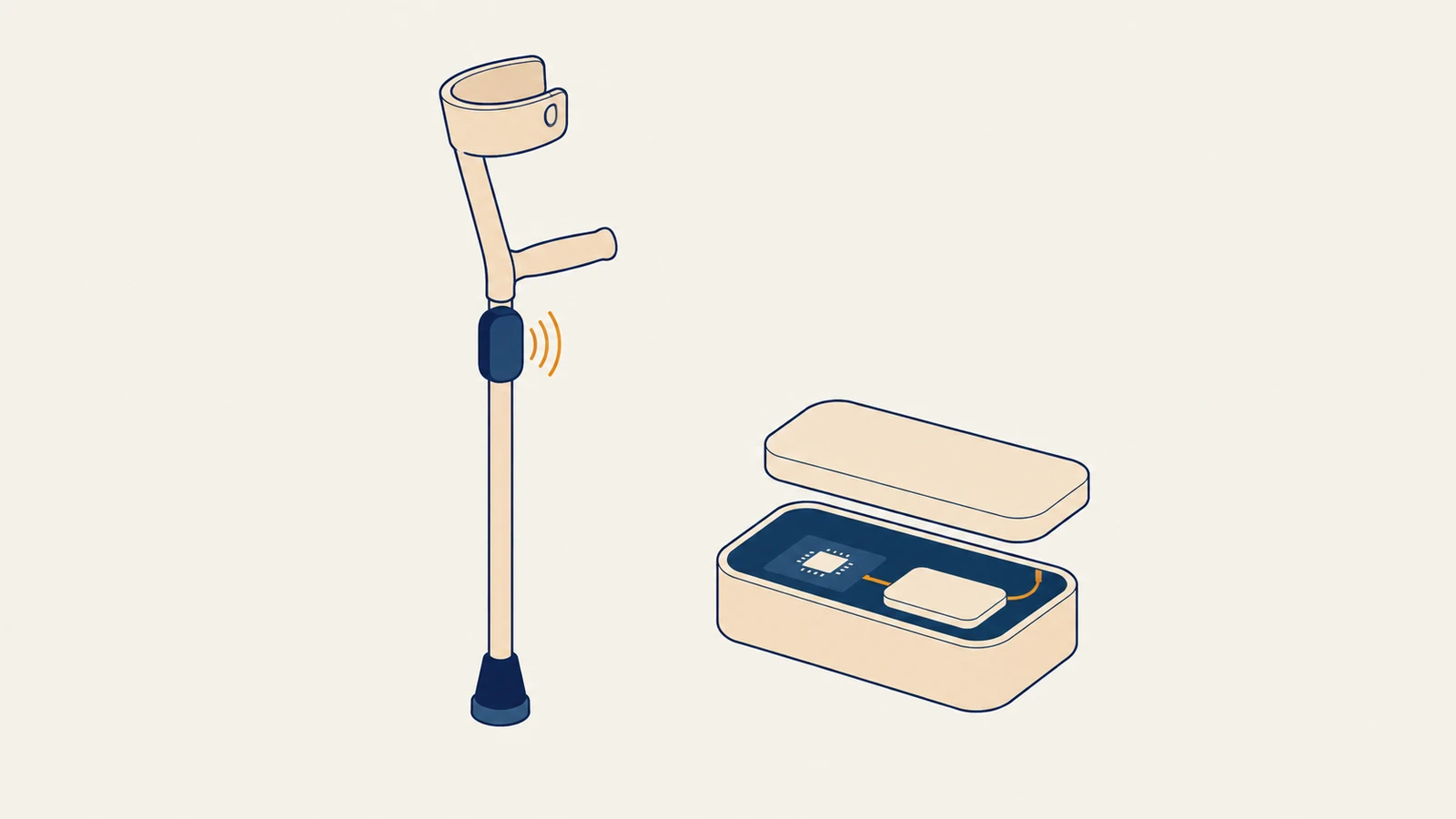
Load-sensing rehabilitation crutch
Load sensors, nRF52 with BLE, an accelerometer, a low-power battery design and an injection-molded housing.
Cold therapy device, concept to clinical trials
Five fully functional prototypes, a thermal model and in-vitro tests before the clinical trial.
Electronics for a rehabilitation chair
Two boards and a remote, firmware under software safety Class B, five pre-production units and a design history file.
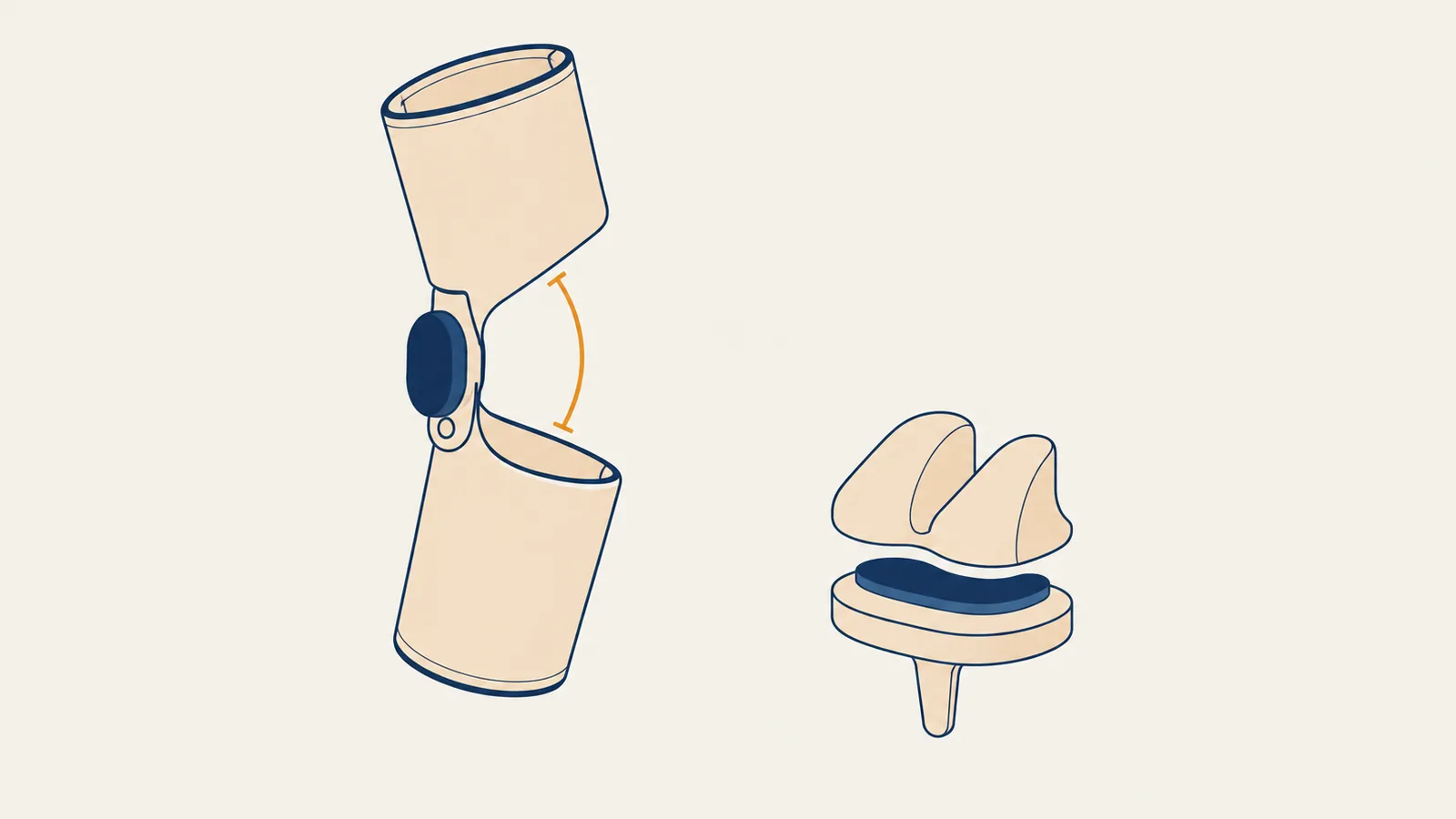
Wearable knee monitor
PCB and embedded software for a knee flexion and gait monitor, and why the flexion estimate should not depend on a magnetometer above a metal implant.
Cranial fixation tool
Press-fit locking geometry, FEA, 100 robotic insertions to study durability and bit wear, then design for manufacturing.
Engineering decisions in orthopedic devices
Measure what the surgeon prescribed
A crutch measures load through the crutch. The prescription is load through the limb. The two are linked by gait pattern, body weight and the other leg, and the link changes from a three-point to a four-point gait. A 2016 comparison of three commercial biofeedback devices against a force plate found agreement of 0.76, 0.58 and 0.19 (weighted kappa) for exactly this reason. The clinical claim should be written against the measured variable, and the inference validated across gait patterns, not standing still on a force plate.
Feedback has to land inside the step
Load information after the step is a report; during the loading phase it is a correction, and only the correction changes gait. That sets the sampling rate, the latency and the actuator, so latency belongs in the requirements as a number. Patient-facing displays are ruled out during walking: looking down on a partially loaded limb is how elderly patients fall. Haptic feedback also performs better: a 2014 study measured 22.4 pounds of loading with haptic feedback against 43.8 with bathroom scale training and 60.3 with verbal instruction.
Claim change over weeks, not an absolute angle
Body-worn inertial sensors measure knee flexion with an error of 4.4 to 9.4 degrees, while the deficits after knee replacement are 4.8 to 6.6 degrees. Most of that error is a roughly constant bias from mounting and soft tissue, which largely cancels when the same device compares week two with week eight. Moving the claim to within-patient change turns the validation into a test-retest design and saves a failed accuracy study.
Keep the magnetometer out of the clinical axis
A knee prosthesis is a mass of cobalt chromium and titanium right under the sensor. In a 2023 case series with prosthesis users, one participant’s discrete-point error reached 29.21 degrees because a microprocessor-controlled prosthetic knee interfered with the magnetometer. Knee flexion is a sagittal rotation, so it can be recovered from the gyroscope bounded by the gravity vector, with magnetic heading kept out of it.
Mounting beats sensor selection
Straps over skin and muscle move relative to the bone, and every millimeter of donning variation shows up as degrees. Strap design, placement against bony landmarks and a short guided posture at the start of each session matter more than the choice between two IMU parts.
Tooling and volume decide unit cost
For an injection-molded ABS or polycarbonate medical housing, our cost modeling gives:
| Annual volume | Unit cost of the housing | Resin per unit | Tooling amortization per unit |
|---|---|---|---|
| 10,000 | $0.51 to $2.45 | $0.15 to $0.35 | $0.20 to $1.50 or more |
| 50,000 | $0.33 to $1.35 | $0.15 to $0.35 | $0.05 to $0.50 |
A program that tools for 50,000 and sells 8,000 is stuck with that cost. We recommend one tool with interchangeable inserts for several configurations and, when the forecast is uncertain, a bridge process for the first production block.
Test the mechanics the way surgeons will use them
For the cranial fixation tool a robotic arm performed 100 standardized insertions under constant torque to measure durability and bit wear before design for manufacturing. Watching real use matters as much as rigs:
And we had a project where surgeons love the technical specs of the device, but the handle was wrong for how they naturally, you know, grip the instruments during like 4-hour procedure. So that’s something you can only learn by watching someone use it.
Published numbers we design against
| What was measured | Published value | Study |
|---|---|---|
| Compliance with partial weight bearing after lower-extremity surgery | 37.5% | 2020 |
| Same, patients 65 and over with femur or pelvic fractures | 22% | 2020 |
| Same, after total knee arthroplasty, day 1 / before discharge | 0% / 2% | 2023 trial |
| Smart insole load measurement against a force plate | Intraclass correlation about 0.97 | 2025 validation |
| Instrumented crutch prototype, load prediction | 99.3% precision | 2016 |
| Knee flexion error of body-worn inertial sensors | 4.4 to 6.0 degrees slow, 5.4 to 9.4 fast movements | 2026 validation |
| Gait deficits more than a year after knee replacement | 4.8 to 6.6 degrees | 2024 systematic review |
| Patient acceptable symptom state after knee replacement | 50 degrees maximum flexion, 1.2 m/s walking speed | 2020 |
In the clinic you get a snapshot like a single frame. The patient walks in they’re nervous. They’re on their best behavior and you measure them for a couple of minutes. But the real recovery doesn’t happen in this frame. So it happens in the other 167 hours at home when no one is watching.
FDA and reimbursement for orthopedic devices in 2026
Orthopedic devices were the second-largest 510(k) panel in 2025: 404 of 3,198 clearances (12.6%), behind radiology. Physical medicine, which covers most rehabilitation equipment, had 111 (3.5%). The most cleared orthopedic product codes were bone fixation plates (54), lumbar fusion devices (29), soft-tissue fixation fasteners (27) and pedicle screw systems (24). In physical medicine powered wheelchairs (29), motorized three-wheeled vehicles (15) and powered muscle stimulators (15) led.
- New in 2026: FDA finalized its guidance on patient-matched guides for orthopedic implants on May 7, 2026.
- New in 2026: non-invasive bone growth stimulators moved from Class III to Class II with special controls, effective May 18, 2026.
- Additive manufacturing: FDA’s 2017 technical considerations guidance is still the current one.
- Non-spinal bone screws: performance criteria under the Safety and Performance Based Pathway, revised November 2024, with testing per ASTM F543. Fracture fixation plates have their own criteria (April 2022), and FDA’s 510(k) guidance for non-spinal plates, screws and washers was finalized in November 2024.
| Area | Test standard | Current version |
|---|---|---|
| Spinal constructs | ASTM F1717 | F1717-21 |
| Intervertebral fusion devices | ASTM F2077 | F2077-24 (F2077-18 accepted by FDA until July 4, 2027) |
| Bone screws | ASTM F543 | F543-23 (F543-17 accepted until December 20, 2026) |
| Bone plates | ASTM F382 | F382-24 (F382-17 accepted until December 20, 2026) |
| Knee wear | ISO 14243-1 and -3 | 2009 and 2014 with 2020 amendments; revision in progress |
| Hip stem and neck endurance | ISO 7206-4 and -6 | 2010 with 2016 amendment; 2013, new edition at DIS ballot |
| FEA of hip stems and knee components | ASTM F2996 and F3161 | F2996-24, F3161-24 |
| Additively manufactured Ti-6Al-4V | ASTM F3001 | F3001-14 (reapproved 2021) |
Remote therapeutic monitoring for musculoskeletal devices
Medicare pays remote therapeutic monitoring (RTM) codes for musculoskeletal devices such as instrumented rehabilitation aids. Since 2026 a device that sends data on as few as 2 days in 30 qualifies for device supply under 98985, at the same amount as 16 to 30 days under 98977.
| Code | What it pays for | 2026 national amount |
|---|---|---|
| 98975 | RTM set-up and patient education (now 2 days of data) | $21.71 |
| 98977 | Musculoskeletal device supply, 16 to 30 days of data in 30 | $51.44 |
| 98985 | Musculoskeletal device supply, 2 to 15 days (new in 2026) | $51.44 |
| 98980 | RTM treatment management, first 20 minutes | $54.11 |
| 98979 | RTM treatment management, first 10 minutes (new in 2026) | $26.39 |
| 98981 | Each additional 20 minutes | $41.42 |
How an orthopedic program runs: two real examples
Rehabilitation chair, electronics and firmware only. The client’s team kept the mechanics; we took the control box, the control panel and the remote.
Discovery about 280 hours
Requirements, interfaces with the client’s mechanics, architecture and the plan.
First prototype about 720 hours
Two boards and a remote, firmware developed under software safety Class B.
Testing and iteration about 500 hours
Bench testing and design changes from the results.
Compliance and documentation
Project management, CTO engagement and the documentation package for a 510(k) submission. Total: 2,100 hours in 16 weeks, $260,000 of engineering, five pre-production units and a complete design history file.
Load-sensing crutch, full cycle. Early prototypes were 3D printed in several materials, then the housing moved to aluminum molds and passed durability tests before 100 pairs were produced. The program took two phases over eight months and about 1,660 engineering hours, with a team of eight across electronics, mechanics, industrial design, quality, business analysis and project management.
Questions
Which orthopedic devices has OVA Solutions built?
A load-sensing rehabilitation crutch (100 pairs produced), a wearable knee monitor, a post-operative cold therapy device that reached clinical trials, electronics for a rehabilitation chair and a cranial fixation tool, among others.
Can a crutch or an insole measure the load on the limb?
Not directly. It measures load through the aid and infers limb load through the gait pattern, which changes between three-point, four-point and single-crutch gait. The claim should be written against what the device measures and validated across gait patterns.
How accurate are wearable knee monitors?
Published error against optical motion capture is 4.4 to 9.4 degrees, about the size of the deficits after knee replacement. Within-patient change over weeks is far more reliable than an absolute angle, so that is the claim we design for.
Can a rehabilitation device be billed under remote therapeutic monitoring?
Medicare RTM codes cover musculoskeletal monitoring: in 2026 device supply pays $51.44 nationally per 30 days under 98977 (16 to 30 days of data) or 98985 (2 to 15 days), plus set-up and treatment management codes. Coverage and billing decisions belong to the clinician; the device has to deliver the data days.
What does an orthopedic device cost to develop?
Two real examples: the rehabilitation chair electronics took 2,100 hours and $260,000 in 16 weeks; the load-sensing crutch took about 1,660 hours over eight months. In Lisa Voronkova’s ranges, a device with a clear architecture on proven technology takes 2,000 to 3,000 hours, and one where new mechanics, electronics and firmware work together takes 5,000 to 6,000. See what development costs.
Do you work under a certified quality system?
Yes. The group’s quality management system is certified to ISO 13485:2016, certificate 044-25 held by Canyon Medical Inc. See our quality system.
Related pages
Working on an orthopedic or rehabilitation device?
Tell us what the device must measure or do and where the patient uses it. On a short call an engineer will point out the claim, the sensor and the mechanics that will decide the program.
Sources
- Lisa Voronkova on BoneChat, June 2026
- Lisa Voronkova on the Global Medical Device Podcast, September 2026 (rehabilitation chair)
- Load sensing is solved. Adherence is the product.
- When measurement error equals the clinical effect: a wearable knee monitor
- OVA Solutions blog: crutch prototypes from 3D printing to aluminum molds
- CMS, CY 2026 Physician Fee Schedule final rule
- CMS, PFS relative value files RVU26A and RVU26D
- openFDA 510(k) API, calendar 2025 by advisory committee and product code
- FDA, Patient-Matched Guides for Orthopedic Implants, May 2026
- Federal Register, reclassification of non-invasive bone growth stimulators, April 16, 2026
- FDA, Technical Considerations for Additive Manufactured Medical Devices, 2017
- ASTM F2077-24
- ASTM F543-23
Updated on October 9, 2026.